What is Video on Demand (VOD) in the IPTV Ecosystem?
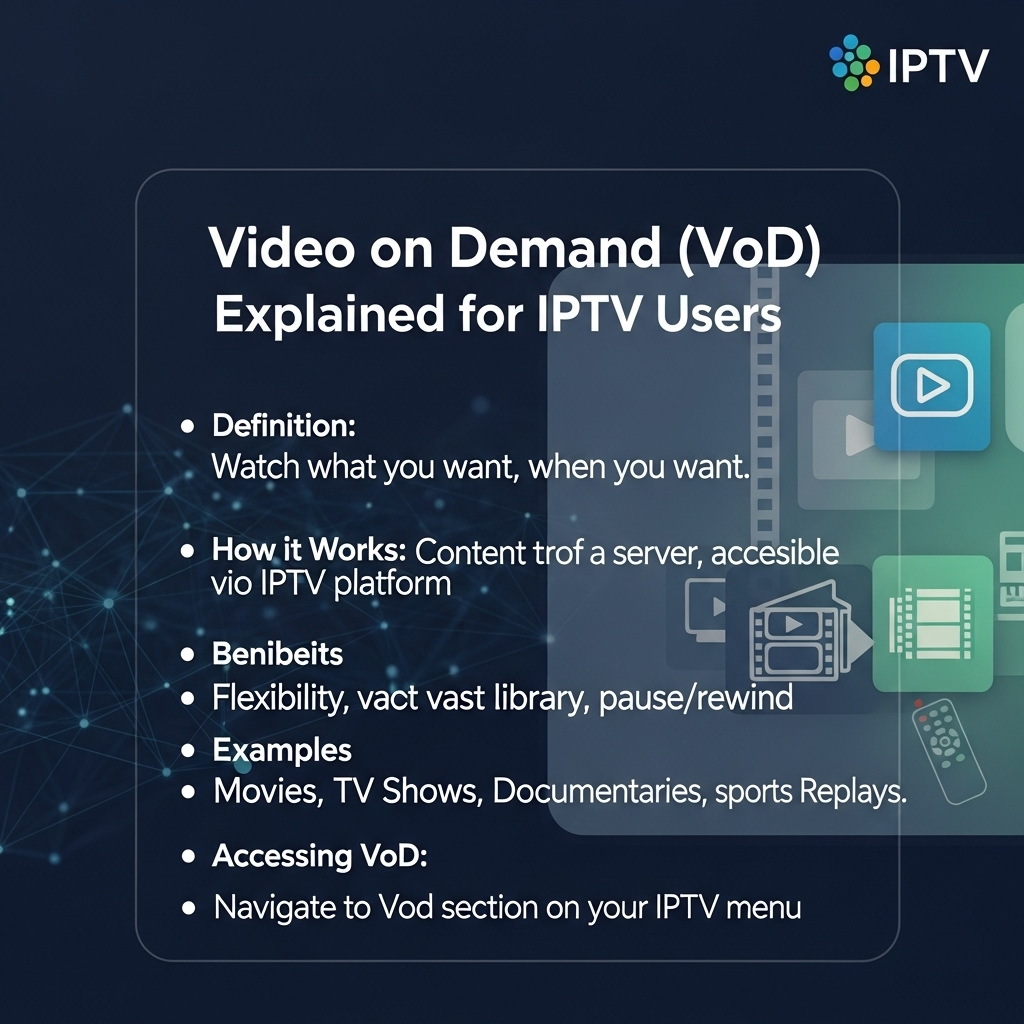
Video on Demand (VOD) is a media distribution system that allows users to access video content like movies, TV shows, or other types of video entertainment whenever they want, rather than following a fixed broadcast schedule. VOD gives users the flexibility to select and watch video content from an online library at their convenience, often through streaming or download services. VOD has revolutionized how we consume media, offering more freedom and convenience than traditional television broadcasting, which relies on scheduled programming. With the rise of VOD platforms like Netflix, Hulu, Amazon Prime Video, and YouTube, users are no longer limited to watching content at specific times. iptvportalonline.com
IPTV (Internet Protocol Television) is the delivery of TV content over the internet rather than through traditional satellite or cable networks. When you combine these two technologies, IPTV Video on Demand is a service that allows users to stream TV shows, movies, and other video content over the internet, choosing what to watch and when to watch it. VOD is one of the three main features of IPTV, along with time-shifted TV (which allows pausing and rewinding live content) and near VOD (staggered live broadcasts). streamhut.tv The key difference is that VOD provides access to stored content that plays when a viewer selects it, often used for a pay-per-view model, while traditional TV requires you to be available at the broadcast time. vimeo.com
“VOD is a revolutionary content distribution system that allows its users to watch selected videos, movies, programs, or live broadcasts at times other than the broadcasting schedule. Previously, this option was available only by recording chosen media on systems like VHS. Today, thanks to audio-visual digitization and the Internet, we can access our preferred content on a TV, personal computer, or other device.” g2a.com
The Three Main VOD Service Models: AVOD, SVOD, and TVOD
VOD services have evolved into three primary business models, each with its own advantages and use cases. Understanding these models is essential for any US-based IPTV user who wants to make the most of their streaming experience. The first model, AVOD (Advertising Video on Demand), provides free content supported by advertisements. The second, SVOD (Subscription Video on Demand), offers access to a content library for a monthly or annual fee. The third, TVOD (Transactional Video on Demand), allows users to pay for specific content, either to rent (DTR) for a limited time or to buy (EST) permanently. vodlix.com
The table below breaks down the key differences between these VOD models:
| VOD Type | Pricing Model | Content Access | Ad Support | US Market Examples |
|---|---|---|---|---|
| AVOD | Free with ads | Limited selection | Yes (frequent) | YouTube, Tubi, Pluto TV |
| SVOD | Monthly/annual subscription | Full library | No (or minimal) | Netflix, HBO Max, Disney+ |
| TVOD | Per-item purchase/rental | Specific content | No | Apple TV, Amazon Video, Vudu |
| DTR | Time-limited rental | Single title | No | 48-hour movie rentals |
| EST | One-time purchase | Own content permanently | No | Digital movie purchases |
The US market has seen a significant shift toward SVOD services, with 85% of US households now subscribing to at least one streaming service. However, the growth of ad-supported models (AVOD) is accelerating, with 30% of US consumers now using these free services. g2a.com This trend is particularly important for IPTV users, as many modern IPTV services are incorporating these VOD models to provide a more comprehensive entertainment experience.
How VOD Technology Works with IPTV: A Technical Breakdown
IPTV services run all their channels on central servers and broadcast them individually to viewers. This technology is called unicasting, which requires significantly less signal bandwidth than the multicasting of traditional television broadcasting. vimeo.com The VOD component of IPTV works by storing content on these central servers, which are then accessed on demand by individual users. When a user selects a VOD title, the content is streamed to their device in real-time, with the option to pause, rewind, or fast-forward.
The technology behind VOD in IPTV systems includes several key components that ensure smooth performance and high-quality streaming. These include:
- Adaptive Bitrate Streaming (ABR): Adjusts video quality based on the user’s internet connection
- Digital Rights Management (DRM): Protects content from unauthorized access
- Content Delivery Networks (CDNs): Distribute content from servers close to the user
- User Interface (UI) and User Experience (UX): The design of the VOD library and navigation
- Ad Insertion Technology: For AVOD services, to place relevant ads
A major advantage of VOD in IPTV is the ability to access content on multiple devices. Whether you’re using a smart TV, streaming device, tablet, or smartphone, VOD content is available across all your screens. This cross-device compatibility is a key reason why 65% of US consumers now consider VOD an essential part of their entertainment experience, up from 42% just three years ago. g2a.com
Benefits of VOD for US IPTV Subscribers
VOD has transformed the way Americans consume entertainment, offering significant benefits that traditional TV cannot match. The most obvious advantage is the complete control over when and what you watch. No more setting VCRs or missing your favorite shows because of scheduling conflicts. VOD also provides a more personalized experience, with content recommendations based on your viewing history. The average US VOD user now watches 12.3 hours of on-demand content per week, a 22% increase from 2022. g2a.com
The US market has embraced VOD for good reason. With 200+ streaming services now available, VOD provides access to a vast content library that would be impossible with traditional TV. The top 10 VOD services in the US now account for 73% of all streaming time, with Netflix, Amazon Prime Video, and Disney+ leading the pack. g2a.com VOD also offers better value for money, as you can access thousands of hours of content for a single monthly fee, rather than paying for expensive cable packages that include many channels you never watch.
“IPTV VOD is a game-changer for US consumers. The ability to watch what you want, when you want, on the device of your choice is no longer a luxury—it’s an expectation. The most successful IPTV services are those that blend live TV with a robust VOD library, creating a complete entertainment solution.” – Industry Expert
VOD vs. Traditional TV: A US Consumer’s Perspective
The shift from traditional TV to VOD has been nothing short of revolutionary in the US market. While traditional TV required consumers to be available at specific times to watch their favorite shows, VOD has put the power in the viewer’s hands. The days of “must-see TV” on Thursday nights are largely over, replaced by the “whenever-see TV” model of VOD. iptvportalonline.com
The key differences between VOD and traditional TV for US consumers:
- Scheduling: VOD = watch anytime; Traditional TV = watch at broadcast time
- Content control: VOD = complete control; Traditional TV = limited to what’s on
- Ad experience: VOD = often ad-free (SVOD) or ad-light; Traditional TV = ad-heavy
- Value proposition: VOD = pay for what you use; Traditional TV = pay for what you get
- Device flexibility: VOD = watch on any device; Traditional TV = limited to TV
A 2023 study found that 68% of US consumers now consider VOD their primary method of content consumption, with only 12% still relying mainly on traditional TV. g2a.com The most significant driver? The ability to watch content on their own schedule. 73% of US VOD users say “time-shifting” (watching when it’s convenient) is the most important feature, followed by the ability to access a wide variety of content (62%).
How to Maximize Your VOD Experience on Your IPTV Service
To get the most out of VOD on your IPTV service, there are several key steps you should take. First, make sure you have a reliable internet connection with at least 25 Mbps for HD content and 50+ Mbps for 4K. Second, check if your IPTV service offers a VOD library and what content is available. Third, look for services that support features like offline downloads, which can be useful for travel. Finally, take advantage of any content recommendations the service provides to discover new shows and movies. streamhut.tv
The most important VOD features to look for in an IPTV service:
- Content library size and quality (number of titles, including recent releases)
- User interface and search functionality (how easy is it to find what you want?)
- Video quality options (SD, HD, 4K, HDR)
- Download capabilities (for offline viewing)
- Simultaneous stream limits (how many devices can stream at once)
- Content update frequency (how often is new content added)
A pro tip: Many IPTV services offer “bundled” VOD content that’s included in your subscription, but they may also have premium VOD content available for an additional fee. Check if your service has a “VOD add-on” that might be worth the extra cost for the content you want. vimeo.com The best way to evaluate a VOD service is to test the free trial period (if available) and see if the content library aligns with your interests and the UI is intuitive to use.
Pro Tip: If you’re using an IPTV service with VOD, look for the “continue watching” feature. This will save your place in a show or movie, so you can pick up right where you left off on any device. It’s a small feature, but it makes a big difference in the user experience. Also, check if your service offers “content categories” that let you filter by genre, year, or even mood—this can help you find exactly what you want to watch in the moment.
The Future of VOD in the US IPTV Market
The VOD landscape is constantly evolving, and several key trends are shaping the future of on-demand content in the US. The first is the increasing personalization of VOD content, with AI-driven recommendations becoming more sophisticated. The second is the growth of interactive VOD, where viewers can make choices that affect the story. The third is the expansion of VOD into new content types, such as live events, sports, and even social media content. vodlix.com
The next few years will see VOD and IPTV become even more integrated, with the following developments:
- More cross-platform functionality (seamless transition between TV, phone, and tablet)
- Advanced ad targeting in AVOD services (more relevant, less intrusive ads)
- Virtual and Augmented Reality content (38% of VOD services are now testing VR/AR) vodlix.com
- Social VOD features (watching with friends remotely, shared comments)
- AI-generated content (personalized news, music, and even video content)
The US VOD market is expected to grow to $120 billion by 2026, with IPTV services playing a major role in this expansion. g2a.com The key to success for both providers and consumers will be understanding the different VOD models and how they can be used to create a personalized, value-driven entertainment experience. As the lines between live TV, time-shifted TV, and VOD continue to blur, the most successful services will be those that offer a seamless blend of all three.
Getting Started with VOD on Your IPTV Service: A Step-by-Step Guide
If you’re new to VOD on your IPTV service, here’s a simple guide to get you started. First, log in to your IPTV service and look for the “VOD” or “On Demand” section in the main menu. This is usually a separate tab or section from the live TV channels. Next, browse the content library to see what’s available. Most services will have categories like “New Releases,” “Top 10,” “Movies,” and “TV Shows” to help you find content. streamhut.tv
The most important things to do when using VOD for the first time:
- Set up your profile (if the service supports multiple user profiles)
- Check the video quality settings (to match your internet connection)
- Look for a “My List” or “Watchlist” (to save content for later)
- Test the search function (to find specific titles)
- Check the content update schedule (to know when new content arrives)
If you’re having trouble finding the VOD section, most IPTV services have a help section or customer support that can guide you. The good news is that VOD interfaces are designed to be user-friendly, with most US services following similar navigation patterns. vimeo.com The more you use VOD, the more you’ll discover its features, from content recommendations to the ability to create your own playlists of favorite shows and movies.
Conclusion: VOD is the Heart of Modern IPTV
VOD has become the cornerstone of the modern IPTV experience, offering US consumers unprecedented control over their entertainment. From the early days of VHS recording to today’s instant access to thousands of titles, the evolution of on-demand content has fundamentally changed how we watch TV. g2a.com The most successful IPTV services are those that have fully integrated VOD into their offering, creating a seamless experience that combines the best of live TV and on-demand content.
As the VOD market continues to grow and evolve, US consumers have more options than ever to create a personalized entertainment experience. Whether you prefer the ad-supported model of AVOD, the all-access approach of SVOD, or the pay-per-title model of TVOD, there’s a VOD service that fits your needs. vodlix.com The key to making the most of VOD is understanding the different models, knowing what to look for in a service, and using the features that enhance your viewing experience. As we move forward, VOD will only become more integrated with our daily lives, making it an essential part of the modern entertainment landscape.