In today’s digital landscape, the terms IPTV and OTT are everywhere, but what do they really mean for consumers and businesses? As an IPTV technology specialist with over a decade of experience in the US market, I’ve watched these two streaming paradigms evolve from niche technologies to mainstream entertainment staples. Understanding the distinction between them isn’t just technical jargon—it’s crucial for making informed decisions about your viewing experience or business strategy.
The rise of internet-based video has fundamentally transformed how Americans consume content, with streaming now accounting for over 40% of all TV viewing time according to recent industry reports. While both IPTV and OTT deliver video over IP networks, they operate on fundamentally different principles that affect everything from picture quality to content availability. In this comprehensive guide, I’ll break down exactly how these technologies differ and help you determine which solution best meets your needs.
What Exactly is IPTV?
Internet Protocol Television (IPTV) represents a specialized streaming technology that delivers television content using Internet Protocol (IP) networks. Unlike traditional broadcast TV that uses satellite or cable signals, IPTV operates over managed, private networks controlled by service providers. This fundamental difference enables the delivery of high-quality, reliable video streams with minimal buffering or quality degradation.
In the United States, IPTV has gained significant traction among telecom companies offering triple-play services (internet, phone, and TV) through their proprietary infrastructure. The key distinction is that IPTV isn’t just streaming content over the public internet—it’s delivered through a dedicated, quality-controlled network that prioritizes video traffic above other data types. This is why your Verizon FIOS or AT&T U-verse TV service rarely experiences the same buffering issues you might encounter with Netflix.
IPTV services typically include three main components: live TV, video on demand (VOD), and time-shifted TV (like catch-up services). These services are often delivered through set-top boxes provided by the ISP, creating a seamless experience that mimics traditional cable TV but with greater interactivity and features.
The managed network approach of IPTV ensures consistent quality of service (QoS) because the provider controls the entire delivery chain. This is particularly important for live events where timing is critical—sports broadcasts, news, and major events benefit from the guaranteed bandwidth and low latency that IPTV networks provide. jazenetworks.com describes this as “a tightly controlled highway with VIP lanes and guaranteed quality” that ensures viewers experience minimal disruption.
Understanding Over-the-Top (OTT) Services
Over-the-Top (OTT) services deliver video content directly to consumers via the public internet, bypassing traditional distribution channels like cable or satellite providers. The term “over-the-top” refers to content providers delivering their services “on top of” existing internet infrastructure without needing a special agreement with your ISP. This is the model that powers streaming giants like Netflix, Hulu, and Disney+.
Unlike IPTV, which requires specialized network infrastructure, OTT works on any internet connection—whether you’re using a cellular network on your smartphone, your home Wi-Fi, or public hotspots. This universal accessibility is why OTT has become the dominant streaming model for on-demand content in the United States, with over 85% of households now subscribing to at least one major service.
The defining characteristic of OTT is its content-first approach. These platforms prioritize content libraries and user experience over network management, which explains why streaming quality can vary based on your internet connection speed and network congestion. As fastpix.io notes, OTT “uses the open internet to deliver media, offering unmatched accessibility and flexibility” but with the trade-off of variable quality.
OTT platforms have revolutionized content consumption by introducing features like personalized recommendations, cross-device synchronization, and adaptive bitrate streaming. The business model typically operates on subscription, advertising, or transactional bases, with content providers maintaining direct relationships with consumers without intermediaries. This direct-to-consumer approach has fundamentally changed the economics of the entertainment industry.
The Critical Differences Between IPTV and OTT
Network Infrastructure and Delivery
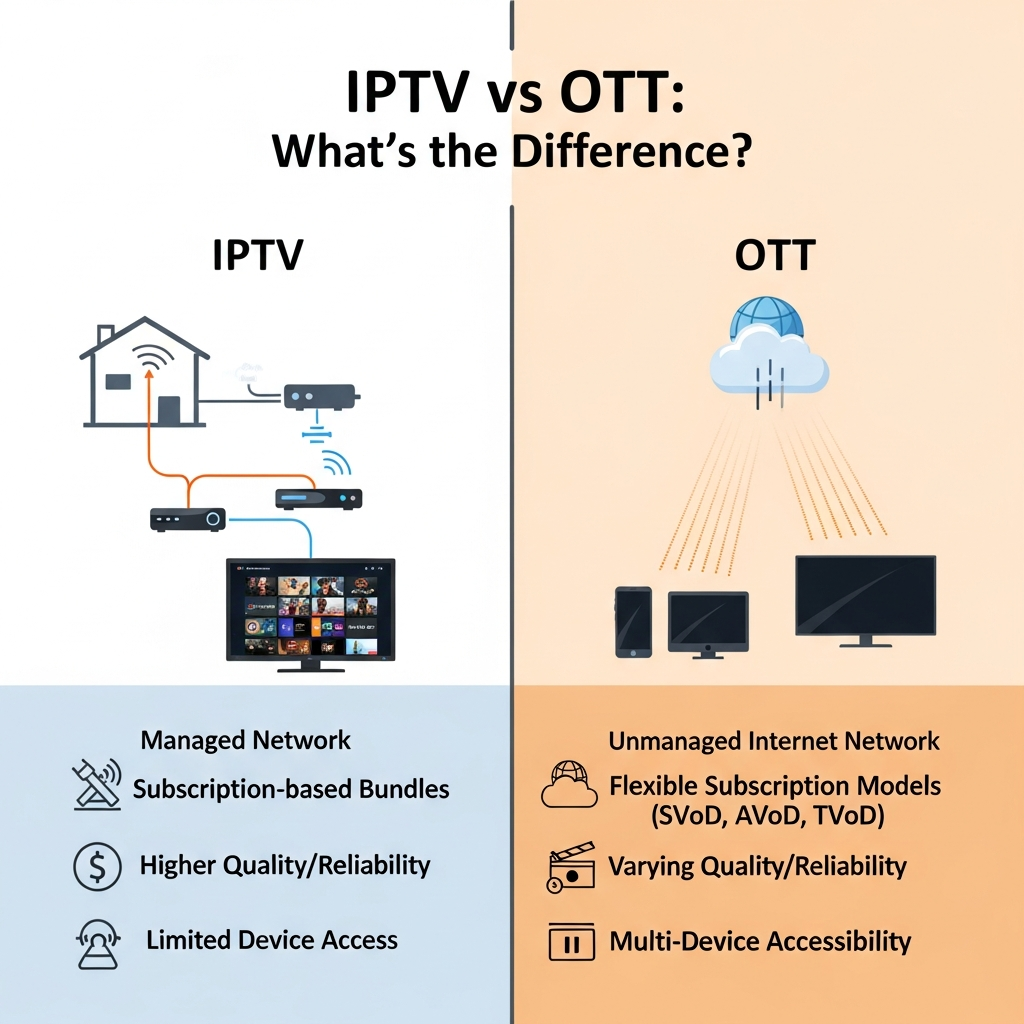
The most fundamental difference between IPTV and OTT lies in the delivery network. IPTV operates over private, managed networks that are specifically designed and optimized for video delivery. These networks are owned and controlled by the service provider, allowing for guaranteed bandwidth allocation and quality of service. OTT, by contrast, uses the public internet infrastructure that wasn’t originally designed for video streaming.
This difference in network approach has significant implications for the end-user experience. With IPTV, your video stream travels through dedicated channels within the provider’s network, similar to having a reserved lane on a highway. With OTT, your stream competes with all other internet traffic for bandwidth, which can lead to quality fluctuations during peak usage times.
The managed nature of IPTV networks means they can support multicast streaming, where a single stream is delivered to multiple users simultaneously—ideal for live broadcasts. OTT typically uses unicast delivery, where individual streams are created for each viewer, making large-scale live events more resource-intensive.
| Feature | IPTV | OTT |
|---|---|---|
| Network Type | Private, managed network | Public internet |
| Quality of Service | Guaranteed (QoS) | Best effort |
| Delivery Method | Multicast for live content | Primarily unicast |
| Bandwidth Control | Provider-controlled | Dependent on user’s internet |
| Network Ownership | Service provider | Internet Service Providers |
| Typical Latency | Low (5-10 seconds) | Variable (15-45+ seconds) |
Content and Service Models
IPTV services typically mirror the traditional TV experience with linear channels, electronic program guides, and scheduled programming. Many IPTV providers offer packages that directly compete with cable TV, including local broadcast channels, premium networks, and sports packages. The content is usually licensed through traditional media agreements similar to cable providers.
OTT services, however, are primarily designed around on-demand content consumption. While many now include live streaming options (like YouTube TV or Hulu Live), their core strength lies in their vast video-on-demand libraries. The content strategy for OTT platforms often focuses on original programming and exclusive content deals to differentiate themselves in a crowded market.
The business models also differ significantly. IPTV services are typically bundled with internet and phone services through ISPs and billed as part of a package. OTT services usually operate on standalone subscription models, though they increasingly offer tiered pricing with advertising-supported options.
Technical Requirements and Compatibility
IPTV generally requires specific hardware provided by the service provider, typically a dedicated set-top box that connects to the managed network. This hardware is optimized for the IPTV delivery system and often includes features like integrated digital video recording (DVR) capabilities.
OTT services, conversely, are designed to work across a wide range of devices without specialized hardware. Any internet-connected device with a compatible app—smart TVs, streaming sticks, smartphones, tablets, and gaming consoles—can access OTT content. This device-agnostic approach has been a key factor in OTT’s rapid adoption.
The protocol differences are also noteworthy. IPTV commonly uses protocols like IGMP for multicast streaming and RTSP for video delivery, while OTT primarily relies on HTTP-based protocols like HLS (HTTP Live Streaming) or DASH (Dynamic Adaptive Streaming over HTTP), which adapt to available bandwidth.
Which Streaming Solution is Right for Your Needs?
For Consumers: Making the Smart Choice
If you value consistent quality for live programming—especially sports and news—and want the familiar channel-surfing experience of traditional TV, IPTV services offered through your internet provider might be the best choice. The reliability and low latency of IPTV make it ideal for households where multiple people watch different content simultaneously without quality degradation.
For those who prioritize content variety, flexibility, and the ability to watch anywhere, OTT services are likely the better option. The vast libraries of on-demand content and the ability to stream on multiple devices make OTT the preferred choice for most American households today. If you travel frequently or want to watch content on your mobile device, OTT’s internet-based delivery gives you the freedom that IPTV typically cannot match.
Consider your internet situation: if you have a reliable, high-speed connection with sufficient bandwidth, OTT will generally provide an excellent experience. However, if your internet is inconsistent or you live in an area with limited broadband options, the managed nature of IPTV might deliver a more reliable viewing experience for live content.
For Businesses and Content Providers
For telecom providers and service operators, IPTV represents a premium service that can be bundled with internet and phone services, creating sticky customer relationships and higher average revenue per user. The controlled environment allows for premium pricing and the ability to offer service-level agreements (SLAs) for video quality.
Content creators and distributors seeking maximum reach with minimal infrastructure investment will find OTT more appealing. By leveraging existing internet infrastructure, they can quickly scale globally without building specialized networks. The analytics capabilities of OTT platforms also provide valuable insights into viewer behavior that can inform content decisions.
The hybrid approach is becoming increasingly common, with many service providers offering both models. For example, a telecom company might provide IPTV for traditional TV service while also offering OTT apps for on-demand content. This “best of both worlds” strategy leverages the strengths of each technology to create a comprehensive offering.
Pro Tip: For businesses implementing streaming solutions, consider your content type first. Live, time-sensitive content (like news or sports) generally performs better on IPTV infrastructure due to lower latency and guaranteed quality. On-demand content with less stringent timing requirements is often more cost-effective to deliver via OTT.
The Future Evolution of Streaming Technologies
The lines between IPTV and OTT are beginning to blur as both technologies evolve. Modern IPTV systems are incorporating more on-demand capabilities while OTT platforms are improving their live streaming performance. The emergence of 5G networks may further bridge the gap by providing the quality and reliability previously associated only with managed networks.
Content delivery networks (CDNs) are becoming more sophisticated at optimizing OTT delivery, implementing features like edge caching and adaptive bitrate streaming that were once exclusive to IPTV systems. Meanwhile, IPTV providers are adopting more flexible business models that resemble OTT services, including à la carte channel options and mobile apps.
The most significant trend is the convergence of these technologies into a more unified streaming ecosystem. As oxagile.com observed, “In 2025, content is flying at us from every direction—Netflix on your phone, live sports in 4K on your hotel TV, YouTube on your fridge.” This multi-device, multi-platform reality is driving both IPTV and OTT toward more flexible, adaptive solutions.
For US consumers, this convergence means greater choice and better experiences regardless of which technology is powering their content. The key will be selecting services that match your specific viewing habits and connectivity situation rather than focusing on the underlying technology.
Making the Right Streaming Choice for You
Understanding the difference between IPTV and OTT is more than just technical knowledge—it’s essential for making informed decisions about how you consume content and potentially how you build streaming services. While IPTV delivers the reliability of traditional TV through managed networks, OTT offers unprecedented flexibility and content variety through the public internet.
The choice isn’t necessarily binary. Many American households now use a combination of both: IPTV services from their internet provider for live TV and local channels, supplemented by multiple OTT subscriptions for on-demand content. This hybrid approach leverages the strengths of each technology to create a comprehensive entertainment ecosystem.
As streaming technology continues to evolve, the distinctions will likely become less pronounced, but the fundamental differences in delivery methodology will persist. For consumers, this means continuing to evaluate services based on quality, content, and value rather than technical specifications alone.
Expert Insight: “For developers and system architects, understanding the fundamental differences between these two technologies is critical. It enables the design of optimized streaming architectures, informed protocol selection, and the ability to address specific business requirements effectively.” fastpix.io
As an IPTV specialist working in the US market, I’ve seen how both technologies serve different but complementary roles in our entertainment landscape. Whether you’re a consumer looking for the best viewing experience or a business planning a streaming strategy, understanding these differences is the first step toward making the right choice for your specific needs.
The future of video streaming isn’t about choosing between IPTV and OTT—it’s about leveraging the right technology for the right content at the right time. By understanding these differences, you’ll be better equipped to navigate the ever-evolving world of internet television.