
In today’s rapidly evolving media landscape, Internet Protocol Television (IPTV) has emerged as the backbone for delivering television content over managed IP networks. Unlike traditional cable or satellite services, IPTV leverages internet protocols to deliver linear TV, video-on-demand (VOD), and interactive services directly to consumers’ screens. The US streaming market continues to explode, with projections indicating streaming services will reach approximately $116 billion in market value within the next five years according to Statista. For US consumers accustomed to seamless streaming experiences, understanding the sophisticated architecture powering these services becomes increasingly relevant.
IPTV represents a fundamental shift from broadcast models to on-demand, personalized television experiences. This technology enables telecom providers, cable companies, and even standalone streaming services to deliver television content through private networks or the public internet while maintaining quality consistency. Unlike OTT (Over-The-Top) services that operate over the open internet without service-level agreements, IPTV typically runs over managed networks with guaranteed quality of service (QoS) parameters—ensuring buffer-free viewing that American audiences now expect as standard. As cord-cutting continues across the United States, with nearly 50% of households abandoning traditional cable packages, the importance of robust IPTV infrastructure grows exponentially.
What Exactly is IPTV? Beyond Traditional Broadcasting
Internet Protocol Television (IPTV) refers to the delivery of television content using internet protocols rather than traditional terrestrial, satellite, or cable TV formats. This distinction is critical for US consumers who may confuse IPTV with services like Netflix or Hulu. While both deliver content over IP networks, IPTV typically operates over managed, closed networks provided by telecom companies with service guarantees, whereas OTT services run over the public internet without quality guarantees.
The key differentiator lies in system architecture and delivery methodology. Traditional cable and satellite TV require dedicated physical infrastructure—miles of coaxial cable or satellite dishes positioned precisely toward orbiting satellites. As Harmonic Inc. explains, “Cable TV requires laying miles and miles of cable, with a video headend to manage and maintain.” In contrast, IPTV leverages existing IP network infrastructure to deliver television services, eliminating much of the costly dedicated hardware while providing greater flexibility for service providers and consumers alike. This architectural difference enables features like network DVR (NDVR), catch-up TV, and personalized content recommendations that have become standard expectations.
Core Components of Modern IPTV Architecture
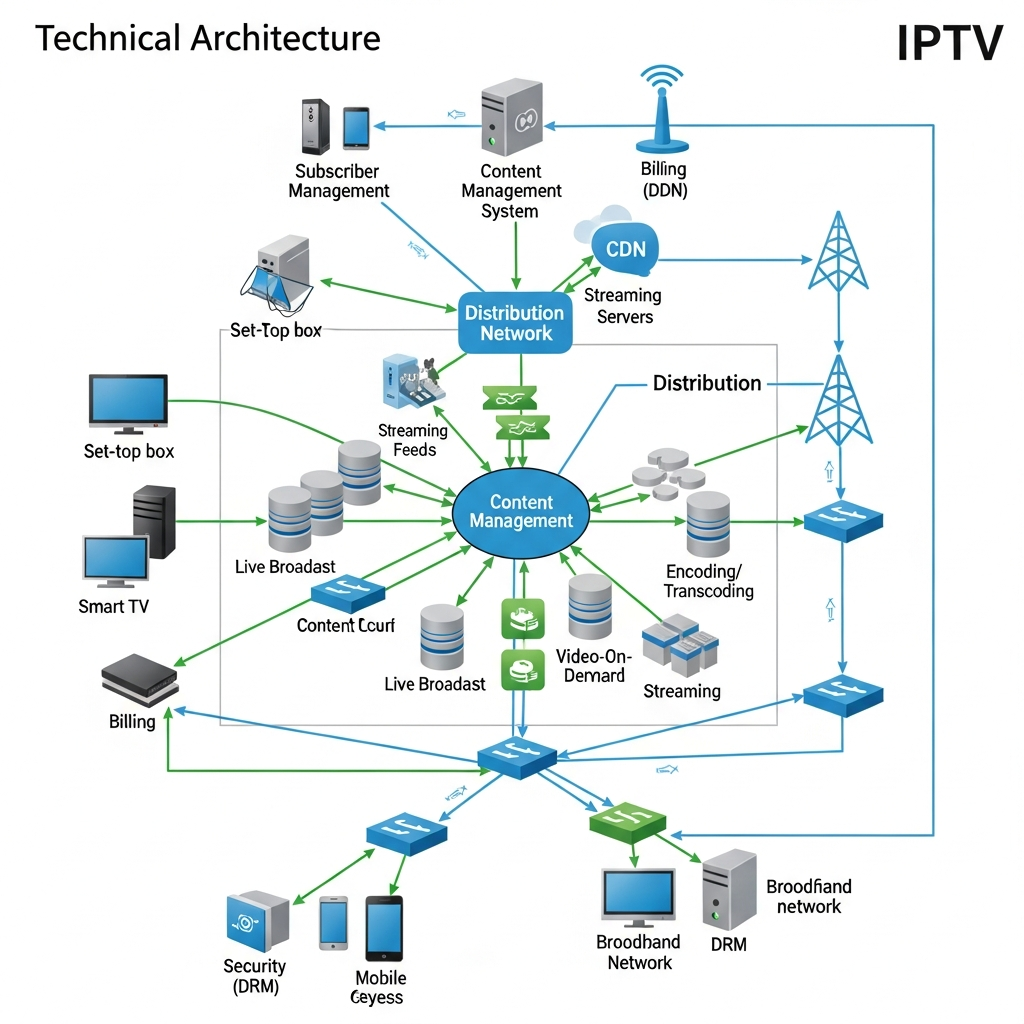
The technical architecture of IPTV comprises several critical components working together seamlessly:
graph TD
    A[Content Sources] --> B[Headend/Content Preparation]
    B --> C[Media Server/Content Delivery]
    C --> D[IP Network/CDN]
    D --> E[Set-top Box/Streaming Device]
    E --> F[End User Device]
At the heart of any IPTV system lies the content preparation and encoding component. Service providers receive content from various sources—live feeds, satellite transmissions, or pre-recorded programming—which then undergoes processing in the headend facility. Here, content is encoded, transcoded, and packaged using standards like MPEG-4 AVC/H.264 or the newer H.265/HEVC formats. Advanced IPTV platforms now implement adaptive bitrate streaming (ABR), creating multiple versions of the same content at varying quality levels to accommodate different network conditions and device capabilities across the United States’ diverse connectivity landscape.
The content delivery network (CDN) represents another critical architectural element. Unlike traditional broadcast models that transmit the same signal to all receivers simultaneously, IPTV utilizes either multicast (for live TV) or unicast (for on-demand content) delivery methods over IP networks. Modern IPTV architectures increasingly leverage cloud-based CDNs that can dynamically route content through optimal pathways, ensuring consistent quality even during peak viewing hours when millions of Americans might be streaming simultaneously. This elasticity proves particularly valuable during major events like the Super Bowl or election night when simultaneous viewership spikes dramatically.
Centralized vs. Distributed: Choosing Your IPTV Infrastructure Model
US service providers typically deploy one of two primary architectural models for their IPTV infrastructure:
| Architecture Type | Key Characteristics | Best For | Bandwidth Efficiency |
|---|---|---|---|
| Centralized | Single master server holds all content; simpler management | Smaller deployments, regional providers | Lower (single point delivery) |
| Distributed | Content replicated across multiple regional servers | National providers, large-scale operations | Higher (local delivery reduces network load) |
As highlighted in industry analysis, centralized architecture “refers to the model in which all content is stored on a central server, removing the need for a comprehensive content distribution system.” This approach simplifies content management but creates significant bandwidth demands as all subscribers pull content from a single location. For national US providers serving millions across diverse geographic regions, distributed architectures offer superior performance by placing content closer to end-users, reducing latency and improving overall quality of experience.
The distributed model provides distinct advantages for the American market with its vast geographic spread and varying network conditions. By deploying edge servers in regional data centers across the country, providers minimize the distance content travels before reaching viewers’ homes. This strategic placement proves crucial during high-demand periods when network congestion could otherwise degrade service quality. While requiring more sophisticated management systems, distributed architectures ultimately deliver the seamless viewing experience US consumers now expect—regardless of whether they’re streaming in New York City or rural Montana.
Content Delivery Mechanics: From Headend to Your Living Room
When a US subscriber selects a program through their IPTV service, a sophisticated orchestration begins behind the scenes. The process starts at the headend, where content sources (satellite feeds, live cameras, stored media) are ingested, encoded, and processed. Modern unified headend systems allow providers to simultaneously service traditional broadcast, IPTV, and OTT delivery channels from a single infrastructure point—a significant operational efficiency for US providers managing multiple service offerings.
The delivery mechanism itself operates through two primary methods:
- Multicast for live television channels – where a single stream serves multiple viewers simultaneously
- Unicast for video-on-demand content – where individual streams are created for each viewer
This distinction impacts network design significantly, as multicast requires specialized network configuration but dramatically reduces bandwidth requirements when many viewers watch the same live program—such as during a primetime sports event viewed by millions nationwide. As noted by Harmonic Inc., “Unlike the IPTV 1.0, which comes in two tiers to support different devices, IPTV 2.0 allows users to support all their devices, including their television, with a single application.”
The Critical Role of Quality of Service (QoS) in IPTV
Quality of Service parameters represent the unsung heroes of reliable IPTV delivery in the US market. Unlike open internet services where data packets travel on a “best-effort” basis, IPTV networks implement strict QoS policies that prioritize video traffic above other network activities. This technical nuance explains why IPTV services typically maintain smooth playback while competing OTT services might buffer during network congestion.
The key QoS mechanisms employed by US IPTV providers include:
- Traffic prioritization – assigning higher priority to video streams
- Bandwidth reservation – guaranteeing minimum bandwidth for video streams
- Jitter buffering – smoothing out irregular packet arrival times
- Packet loss recovery – implementing forward error correction
“With 5G on the horizon, satellite distribution models may not be the most cost-efficient for some service providers as C-Band reclaim constraints increase. IPTV makes it possible to deliver media feeds directly to the subscriber’s set-top boxes over the internet, eliminating costly headend equipment,” explains industry analysis from Harmonic Inc..
Without these QoS mechanisms, the buffer-free experience Americans have come to expect would be impossible during peak usage hours when network congestion typically occurs. Service providers carefully engineer their networks to ensure video packets receive preferential treatment, often implementing end-to-end QoS policies from the headend through the last mile to the customer premises.
Security Architecture: Protecting Premium Content
As IPTV delivers premium content worth billions in subscription revenue, robust security architecture remains non-negotiable for US providers. The security framework operates at multiple levels:
flowchart TD
    A[Content Encryption] --> B[Conditional Access System]
    B --> C[Set-top Box Security]
    C --> D[Network Security Protocols]
    D --> E[User Authentication]
Content encryption using standards like AES-128 or AES-256 protects content during transmission, while conditional access systems (CAS) and digital rights management (DRM) control who can access specific content. Unlike OTT services that primarily rely on application-layer security, IPTV employs network-layer security protocols that integrate with the delivery infrastructure itself.
“IPTV services combine the benefits of traditional broadcasting with the convenience of streaming content from any location and device,” notes an IEEE publication on IPTV security, highlighting the dual challenge of securing both the content and delivery infrastructure. US providers face particular scrutiny regarding content protection due to strict copyright enforcement and high-value content deals with major studios.
Advanced IPTV systems now implement forensic watermarking that embeds unique, invisible identifiers in each viewer’s stream—enabling content owners to trace unauthorized redistribution back to the original subscriber. As piracy methods evolve, so too does the security architecture protecting billions in subscription revenue for US service providers.
IPTV 2.0: The Next Evolution of Streaming Architecture
The industry has reached an inflection point with what experts term “IPTV 2.0″—an architectural evolution addressing limitations of first-generation IPTV systems. As explained by Harmonic, “IPTV seems like the next logical step for entertainment distribution services and has been steadily increasing in popularity worldwide; however, IPTV is nearing the end of its growth cycle. The time has come for IPTV to evolve.”
Key advancements in IPTV 2.0 include:
- Elimination of dedicated set-top boxes through smart TV integration
- Unified application frameworks supporting all devices from a single codebase
- Advanced advertising capabilities including server-side ad insertion (SSAI)
- Cloud-native architectures enabling rapid feature deployment
This evolution responds directly to US consumer demands for seamless experiences across devices—from living room televisions to mobile phones—without the friction of multiple applications or inconsistent interfaces. IPTV 2.0 architectures support the personalized, high-quality experiences American viewers now expect as baseline functionality.
Cloud-Native IPTV: Revolutionizing Delivery Infrastructure
The migration to cloud-native IPTV architectures represents perhaps the most significant transformation in the industry’s technical landscape. By moving core functions like transcoding, content packaging, and delivery management to cloud environments, US providers gain unprecedented flexibility and scalability.
Cloud-Native IPTV Benefits:

✓ Elastic scalability during peak demand events
✓ Faster deployment of new features and services
✓ Reduced capital expenditure on physical infrastructure
✓ Enhanced personalization capabilities through AI/ML
✓ Improved disaster recovery and redundancy
“Packaging and origin deployed in the cloud allows service providers to benefit from the cloud’s inherent scalability and flexibility. The cloud offers new content personalization workflows, and eases implementation of personalized and dynamic advertising,” according to Harmonic Inc.’s analysis.
This cloud transition enables US providers to dynamically scale resources during major events—like Super Bowl Sunday when streaming demand spikes dramatically—without maintaining expensive underutilized infrastructure during normal operations. It also facilitates advanced features like real-time content personalization and dynamic ad insertion that drive higher advertising revenues.
Future-Proofing Your IPTV Technical Architecture
As 5G networks expand across America and consumer expectations continue evolving, forward-thinking IPTV architecture must anticipate several emerging trends:
- Convergence of fixed and mobile networks requiring unified delivery architectures
- AI-driven content personalization demanding more flexible backend systems
- Immersive video experiences like 4K HDR, 8K, and eventually holographic content
- Tighter integration with smart home ecosystems
Service providers that embrace modular, cloud-native architectures today will be best positioned to incorporate these innovations without costly rip-and-replace scenarios. The most successful US IPTV platforms will treat their technical architecture not as static infrastructure but as evolving platforms capable of integrating new capabilities as consumer demands change.
Pro Tip: Key Consideration for US IPTV Deployments
When designing IPTV infrastructure for the US market, prioritize adaptive bitrate ladder optimization specific to American broadband profiles. Unlike many international markets, US internet speeds vary dramatically—from gigabit fiber in urban centers to slower DSL/cable in rural areas. Create bitrate ladders that:
- Start low enough (200-300kbps) to serve viewers with limited connectivity
- Include multiple mid-range options (1-5Mbps) for mainstream broadband
- Feature high-bitrate tiers (15-25Mbps) for 4K capable households
This ensures maximum accessibility while delivering premium quality where networks support it—a critical balance in America’s heterogeneous connectivity landscape.
Conclusion: The Architecture Behind America’s Streaming Revolution
The technical architecture powering IPTV systems represents a sophisticated symphony of network engineering, content management, and delivery optimization that most US consumers never see but absolutely depend on. As streaming continues to dominate American television consumption, understanding this architecture becomes increasingly valuable—not just for providers building these systems, but for consumers who increasingly expect seamless, personalized television experiences across all their devices.
From the content preparation at headends to the final milliseconds before pixels appear on screen, IPTV architecture demonstrates how technical innovation can transform traditional industries. As the industry continues evolving toward IPTV 2.0 models with cloud-native designs and unified delivery frameworks, American viewers can anticipate even more personalized, reliable, and feature-rich television experiences that meet their ever-growing expectations. The next time you seamlessly switch from live sports to a movie on demand without a single buffer, remember the sophisticated architecture working behind the scenes to make it possible.