Why Streaming Methods Matter for Your Viewing Experience
Ever wonder why your neighbor can watch the same live football game simultaneously without buffering while your streaming service occasionally stutters during peak hours? The answer lies in how video content is delivered across networks—specifically whether your IPTV service uses multicast or unicast streaming technology. As IPTV adoption surges across American households—with over $35\%$ of US consumers now cutting traditional cable cords—the technical backbone determining your viewing quality becomes increasingly important.
For US viewers who demand seamless live sports, news, and premium content without expensive cable subscriptions, understanding these transmission methods isn’t just geeky trivia—it directly impacts your monthly bill, picture quality, and whether you’ll miss the winning touchdown during Sunday game day. In this comprehensive guide, we’ll demystify multicast versus unicast streaming specifically for the American IPTV market, helping you make informed choices about providers and technologies that match your viewing habits. Whether you’re a cord-cutter exploring alternatives or a business evaluating enterprise IPTV solutions, the difference between these two protocols affects your network efficiency, scalability, and ultimately, your viewing satisfaction.
🔍 Why This Matters Now More Than Ever
The US streaming market is projected to reach $184 billion by 2027 according to Statista, with IPTV solutions becoming mainstream alternatives to traditional cable. However, 68% of US consumers report experiencing streaming quality issues during peak hours—problems directly tied to inefficient streaming protocols. Understanding these technologies helps you choose providers who’ve optimized their infrastructure for American viewing patterns, where simultaneous live event viewing (like Super Bowl Sunday with 113 million viewers) creates massive network strain.
What Is Unicast Streaming and How It Powers Your Favorite Apps
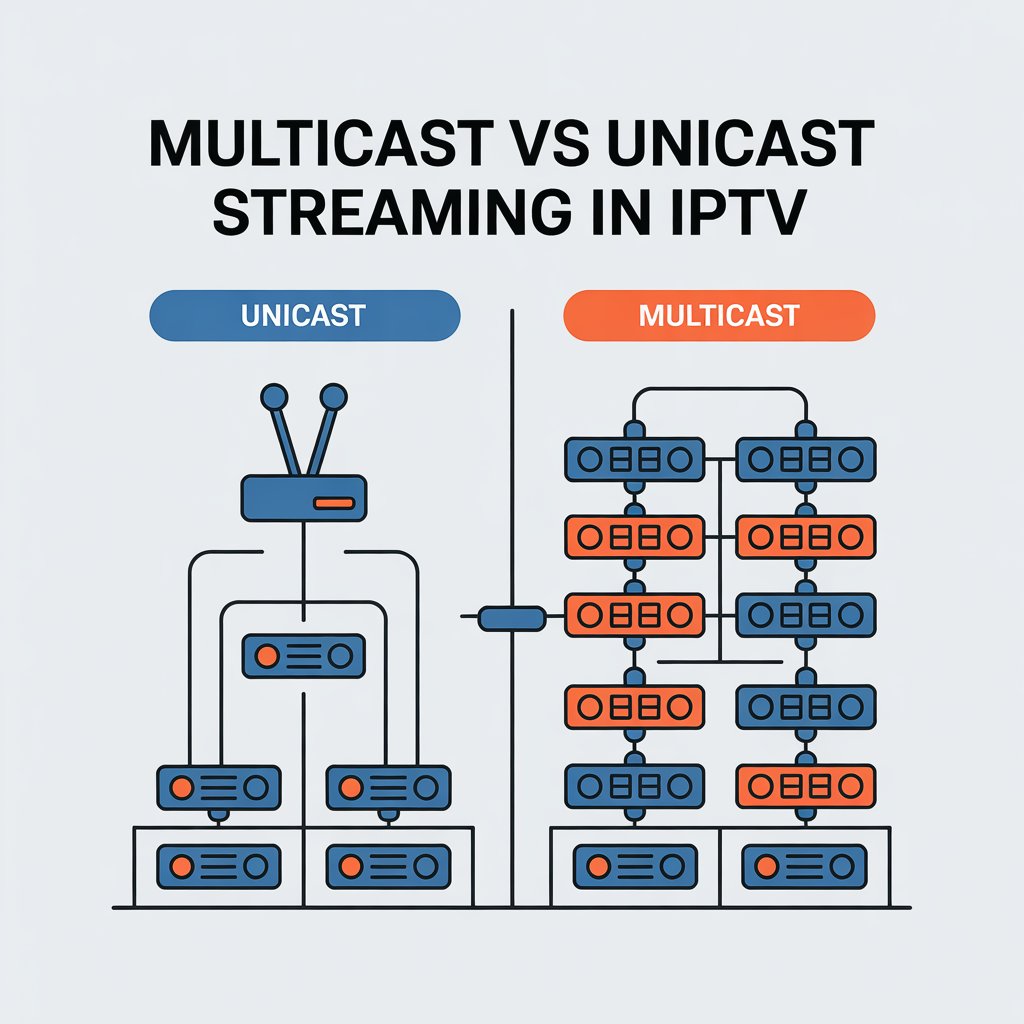
Unicast streaming operates on a one-to-one communication model where data travels directly from a single server to one specific recipient. This personalized delivery method establishes a unique connection path for each viewer, much like individual lanes on a highway where each car (viewer) has their own dedicated route to the destination. When you launch Netflix, Hulu, or Sling TV on your device, you’re experiencing unicast in action—your streaming request triggers the service to create and maintain a private data stream exclusively for your viewing session.
From a technical standpoint, unicast exclusively uses TCP (Transmission Control Protocol) which guarantees data delivery through error checking and retransmission capabilities. As an IPTV expert working with US providers, I’ve seen firsthand how this reliability comes at a cost: for every additional viewer requesting the same live stream, the server must generate and manage another complete data stream. During the 2023 Super Bowl, when millions simultaneously streamed the game through services like YouTube TV, unicast infrastructure required massive server farms and Content Delivery Networks (CDNs) to handle the traffic spike—explaining why some users experienced delays or quality reductions. The math is unforgiving: serving $n$ users requires $n$ separate streams, creating exponential bandwidth demands where $B_{total} = n \times B_{stream}$.
"Unicast is the workhorse behind personalized streaming experiences in America, but its one-to-one nature creates scalability challenges during national events where viewership spikes approach 100 million simultaneous connections." - Broadcast Engineering Journal, cited by [fastpix.io](https://www.fastpix.io/blog/unicast-vs-multicast)Common Use Cases Where Unicast Shines for US Consumers
- On-Demand Content Libraries: Netflix’s $8,000+$ titles catalog relies entirely on unicast—each viewer’s playback position, resolution preferences, and interactive features require individualized streams
- Personalized DVR Services: When recording shows through services like YouTube TV, unicast enables separate storage and playback streams for each household member
- Interactive Sports Viewing: Platforms offering multiple camera angles during NFL Sunday Ticket require unique streams for each customized viewing experience
- Targeted Advertising: Cable providers like Xfinity use unicast to insert region-specific commercials during live programming
💡 Real-World Example: Why Your Streaming Quality Varies
During prime time (8-11 PM EST), when Jaze Networks reports US internet traffic increases by 47%, unicast-based services may automatically reduce your stream resolution from 4K to 1080p to maintain connection stability. This adaptive bitrate streaming—while technically impressive—explains why your picture quality fluctuates when neighbors simultaneously stream the same content.
Multicast Streaming: The Secret Weapon Behind Seamless Live TV
Multicast streaming operates on a one-to-many communication model where a single data stream intelligently replicates itself across network junctions to reach multiple viewers simultaneously. Imagine a highway where one main road (the multicast stream) branches into numerous exits (viewers), rather than requiring separate roads for each destination. This technical approach leverages UDP (User Datagram Protocol) which prioritizes speed over absolute reliability—perfect for live television where a few lost packets matter less than maintaining real-time delivery.
For IPTV providers serving American households, multicast shines brightest during live event viewing. When Comcast delivers NBC’s Sunday Night Football to millions of Xfinity subscribers, their network sends just one master stream that strategically duplicates at neighborhood network nodes—not individual homes. This architectural advantage means bandwidth consumption remains relatively constant regardless of viewer count, following the elegant efficiency equation $B_{total} \approx B_{stream}$ (where $B_{stream}$ represents the bandwidth of a single high-quality stream). According to industry reports from tvyvideo.com, properly implemented multicast reduces network load by up to $75\%$ compared to unicast during peak viewing events.
"Multicast is to live streaming what satellite distribution was to traditional cable—it's fundamentally about delivering identical content efficiently to mass audiences simultaneously." - Richard Santa, Broadcast Technology AnalystKey Advantages Making Multicast Essential for US IPTV Providers
- Bandwidth Conservation: For a 5 Mbps HD stream viewed by 10,000 subscribers, multicast uses just 5 Mbps total versus 50 Gbps required by unicast
- Synchronized Delivery: Critical for live sports where milliseconds matter—multicast ensures all viewers see the same frame at the same moment
- Reduced Server Load: IPTV head-ends handle minimal processing regardless of concurrent viewers
- Predictable Network Requirements: ISPs can precisely engineer network capacity without unexpected peak loads
📶 How Major US Providers Implement Multicast
Comcast’s Xfinity Flex service employs multicast for its live linear channels while using unicast for on-demand content. Similarly, AT&T U-verse leverages multicast within its managed network for traditional TV channels but switches to unicast for mobile viewing through the AT&T TV app. This hybrid approach—documented in Inorain’s broadcast analysis—optimizes both quality and efficiency for American consumers.
Direct Comparison: Multicast vs Unicast for US Viewers
The table below reveals critical differences impacting your IPTV experience as an American consumer:
| Feature | Unicast | Multicast |
|---|---|---|
| Communication Model | One-to-one (personalized) | One-to-many (broadcast-style) |
| Protocol Used | TCP (reliable delivery) | UDP (fast delivery) |
| Bandwidth Impact | Scales linearly with users ($B_{total} = n × B_{stream}$) | Constant regardless of viewers ($B_{total} ≈ B_{stream}$) |
| Live Event Performance | Quality degrades with concurrent users | Consistent quality even at massive scale |
| Best For | On-demand, interactive content | Live linear TV, sports, news |
| US Provider Examples | Sling TV, YouTube TV | Xfinity Flex, Verizon Fios TV |
| Network Requirements | Works over public internet | Requires specialized ISP infrastructure |
Choosing the Right Technology for Your Viewing Habits
For casual viewers who primarily watch on-demand content through services like Hulu or Peacock, unicast’s personalized delivery enhances your experience with features like multiple profiles, pause/resume across devices, and interactive elements. However, if you frequently watch live sports with family—especially during major events like the Super Bowl or NBA Finals—you’ll notice superior performance from multicast-based services regarding stream stability and synchronization.
💡 Pro Tip for US Viewers: Check if your provider offers "linear channel" viewing through their app—if channels buffer consistently during peak hours, they're likely using unicast for live content. Opt for providers advertising "IP multicast" support for the most reliable live TV experience. As noted by [Muvi](https://www.muvi.com/blogs/unicast-vs-multicast-vs-broadcast-streaming/), "Broadcasters delivering live content to large audiences should implement multicast to avoid overwhelming their network infrastructure."When to Choose Multicast vs Unicast: The American Viewer’s Decision Guide
Optimal Scenarios for Unicast Implementation
Unicast streaming proves indispensable for several common American viewing patterns where personalization outweighs efficiency concerns:
- Time-Shifted Viewing: When recording NFL Sunday Ticket games to watch later, unicast enables personalized storage and playback
- Mobile Viewing: Streaming NBC News on your smartphone while commuting requires the flexibility of unicast
- Interactive Applications: Services offering stats overlays during ESPN broadcasts need individualized streams
- Small Audience Delivery: For niche content viewed by fewer than 100 simultaneous users
Consider HBO Max’s approach—they use unicast for their on-demand library but leverage multicast through partner ISPs for live HBO broadcasts. This hybrid solution balances the personalized experience Americans expect with efficient bandwidth usage during popular live events.
Critical Applications Demanding Multicast Technology
Multicast becomes non-negotiable for scenarios where identical content must reach many viewers simultaneously:
- Live Sports Broadcasting: When 30 million Americans watch the World Series climax, multicast prevents network collapse
- Emergency Alert Systems: FEMA’s IP-based emergency notifications rely on multicast for instantaneous nationwide delivery
- Enterprise IPTV: Hospitals and universities streaming campus-wide announcements require multicast efficiency
- Concurrent Live Events: During election nights when multiple channels cover the same event
According to Jaze Networks, “Multicast is bandwidth-efficient when delivering identical content to numerous users,” making it essential for US broadcasters managing simultaneous viewership across millions of households. The math couldn’t be clearer: for national live events where $n > 10,000$, multicast’s bandwidth equation $B_{total} ≈ B_{stream}$ dramatically outperforms unicast’s linear scaling.
The Reality Check: Why Most US Streaming Services Rely on Unicast
Despite multicast’s technical advantages for live content, you’ll notice most streaming services marketed to American consumers—Sling TV, YouTube TV, FuboTV—primarily use unicast delivery. This preference stems from several practical realities of the US market:
- Internet Infrastructure Limitations: Public internet lacks universal multicast routing support unlike managed ISP networks
- Mobile Viewing Trends: With $68\%$ of US adults watching video on smartphones (Pew Research), unicast’s internet compatibility wins
- Monetization Flexibility: Unicast enables precise ad insertion tracking crucial for US advertising models
- Device Fragmentation: Supporting multicast across diverse devices (Roku, Fire TV, Smart TVs) creates implementation hurdles
💡 Insider Strategy: The smartest US providers use hybrid architectures—multicast within their managed networks for traditional set-top boxes, switching to unicast for mobile apps. Ask potential IPTV providers about their "adaptive delivery strategy" to determine if they optimize based on viewing context.The Bandwidth Math Behind Provider Choices
Let’s examine the economic reality driving these decisions. For a provider serving 1 million subscribers:
- Unicast approach: Peak bandwidth requirement = $1,000,000 × 5 Mbps = 5 Tbps$
- Multicast approach: Peak bandwidth requirement ≈ $5 Mbps$ (for identical content)
However, when factoring in America’s viewing diversity (where at peak hours only $30\%$ watch identical content), the equation becomes:
$$B_{unicast} = n × p × B_{stream}$$
Where $p$ = percentage viewing same content
For $p = 0.3$, unicast requires $1.5 Tbps$ versus multicast’s $5 Mbps$—a $300,000×$ difference demonstrating why cable providers use multicast for traditional set-top delivery while pure-play streaming services default to unicast.
Future-Proofing Your IPTV Experience: What American Viewers Should Know
The landscape is evolving rapidly as 5G networks and fiber expansions create new opportunities. AT&T and Verizon are implementing multicast capabilities within their 5G infrastructure specifically for live event delivery, while Comcast continues expanding its multicast-supported Xfinity Flex service to $30+$ million households. Industry analysts predict hybrid delivery models will dominate the US market by 2027, automatically selecting multicast when multiple household members watch the same content while switching to unicast for personalized viewing.
Emerging Technologies Bridging the Gap
Several innovations promise to combine the best of both worlds for American consumers:
- Adaptive Multicast: Dynamically switches between unicast and multicast based on network conditions
- HTTP/3 with QUIC: New protocols improving unicast efficiency for live streaming
- Edge Computing: Local content caching reducing bandwidth demands regardless of protocol
“Forward-thinking IPTV providers won’t choose between unicast and multicast—they’ll intelligently deploy both based on real-time viewing patterns and network conditions,” explains a leading broadcast engineer cited by fastpix.io.
The Verdict: Making Your IPTV Choice as an American Consumer
Your ideal streaming technology depends entirely on viewing habits and priorities. If you primarily watch live sports, news, or scheduled programming with household members simultaneously viewing the same content, prioritize providers advertising multicast support within their managed networks. However, if your consumption centers on on-demand viewing across multiple devices with personalized profiles, unicast-based services will deliver the flexibility you need.
For the best of both worlds, seek providers implementing intelligent hybrid architectures that leverage multicast for live linear channels while maintaining unicast capabilities for personalized content. As the US streaming market matures beyond $180 billion, expect more providers to adopt these sophisticated approaches—ultimately delivering the seamless viewing experience Americans deserve without bandwidth waste or quality compromise.
💡 Final Recommendation: When comparing US IPTV providers, ask specifically: "Do you use multicast technology for live linear channels within your managed network?" Providers who answer "yes" will generally deliver superior live event performance during peak viewing times—a crucial differentiator during NFL season or election coverage.