You’re settling in to watch the Super Bowl on your favorite streaming service. The kickoff is seconds away, but instead of roaring crowds, you’re staring at that dreaded spinning wheel. Buffering ruins the magic of live sports, and it’s why IPTV content delivery has become the unsung hero of modern streaming. Over 100 million US households now rely on IPTV services, with projections showing streaming revenue will hit $116 billion within five years (Statista via iptvbasics.com). But what happens behind the scenes to transform raw video feeds into flawless 4K streams on your screen?
Unlike traditional cable that requires miles of coaxial wiring (iptvbasics.com), IPTV leverages internet protocols to deliver television content through managed IP networks. The key difference? While Netflix and Hulu operate as over-the-top OTT delivery services over the public internet, IPTV typically runs on private networks with guaranteed quality of service (QoS). This technical distinction explains why IPTV avoids the buffering that plagues free streaming services—nearly 50% of US households have cut the cord, demanding cable-like reliability without the infrastructure (iptvbasics.com).
In this deep dive, we’ll unpack how providers turn complex IPTV streaming technology into seamless experiences. You’ll discover why CDNs are the backbone of delivery, how adaptive streaming prevents buffering, and why multicast technology is crucial for live events. Stick around—we’ll also share pro tips for choosing services that won’t fail during the big game. Ready to stop guessing why your stream buffers? Let’s pull back the curtain on the infrastructure keeping America streaming.
What is IPTV Content Delivery? The Engine Behind Your Streams
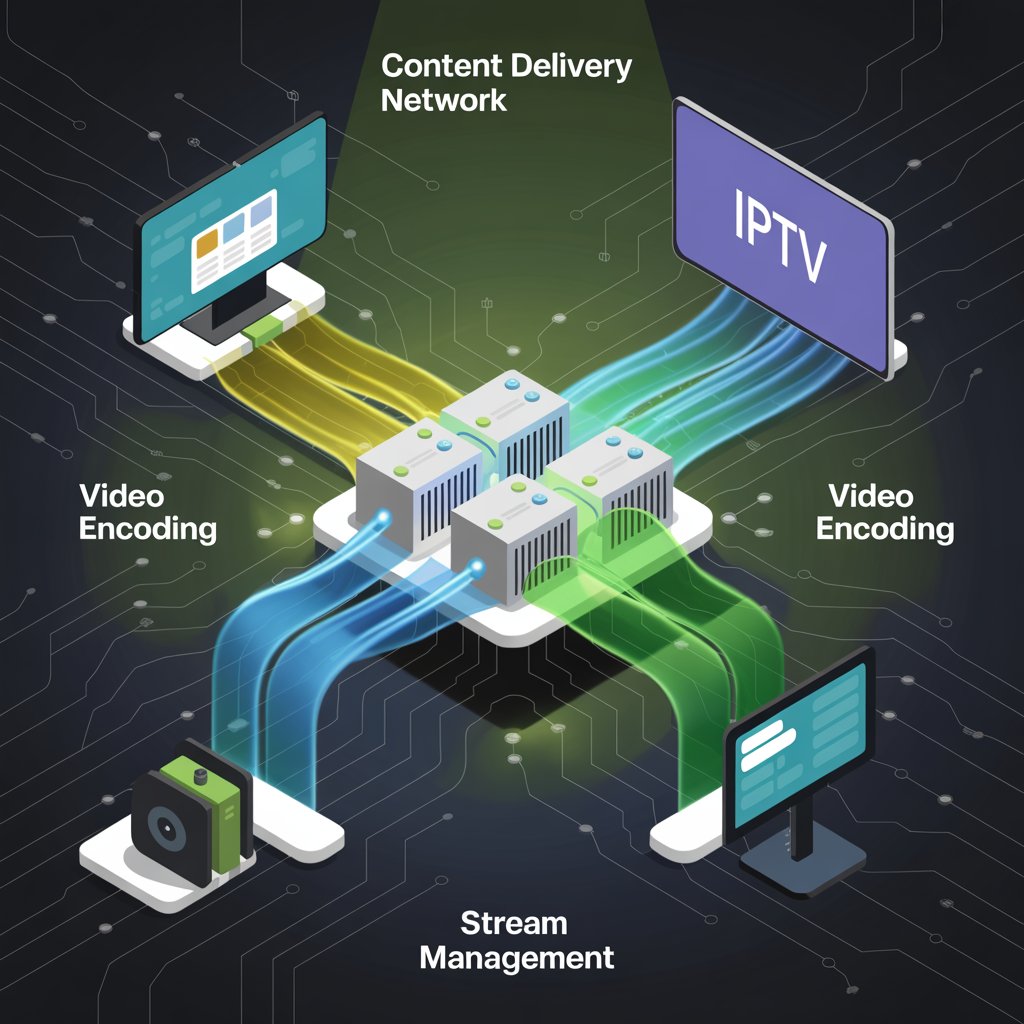
IPTV content delivery refers to the complete pipeline that transforms raw video sources into the streams you watch—from satellite feeds to your living room screen. At its core, this process involves three critical phases: content ingestion, processing, and stream distribution. Unlike traditional broadcast models where signals radiate outward indiscriminately, IPTV operates on a request-driven architecture. When you click “Play,” your device sends a signal through your ISP to an IPTV server, which then retrieves and transmits the requested content.
🔍 Key Difference: IPTV vs. Traditional TV Delivery
Traditional cable/satellite: Broadcasts all channels continuously to every household (like a radio station). You’re receiving 200+ channels whether you watch them or not.
IPTV: Delivers only requested content (like ordering à la carte). Your set-top box “pulls” specific streams when you change channels.
This system relies on specialized infrastructure distinct from standard internet streaming. While OTT services like YouTube use public internet pathways without traffic guarantees, IPTV typically operates on managed networks with strict QoS parameters. As streamhut.tv explains, “IPTV servers act as the heart of the network, managing content encoding, user authentication, and bandwidth optimization to prevent interruptions during peak viewing.”
The end-to-end workflow includes five critical stages:
- Content Acquisition: Licensing live channels and video on demand VOD libraries from rights holders (modeiptv.ca)
- Ingestion: Capturing satellite feeds or digital files into the provider’s system
- Processing: Transcoding raw video into stream-ready formats (more on this later)
- Storage & Caching: Placing content on regional servers for rapid access
- Delivery: Transmitting streams to your device via optimized network paths
This architecture enables features impossible with traditional TV—like pausing live sports or restarting a show from the beginning. But it also introduces technical challenges: How do providers serve 50,000 concurrent viewers watching the same live event without collapse? The answer lies in intelligent network design and the unsung hero of modern streaming: the content delivery network CDN.
The Role of Content Delivery Networks (CDN) in IPTV
When you stream a live NFL game through IPTV, your request doesn’t travel to a single central server in California—it’s routed to the nearest available node in a global content delivery network CDN. Think of CDNs as a network of local libraries strategically positioned across the country. Instead of every New York viewer fetching the same stream from Los Angeles (adding 80ms+ latency), the CDN stores copies at edge locations in Manhattan, Brooklyn, and Newark. This edge caching strategy slashes delivery time from hundreds of milliseconds to under 20ms.
dtiwebfiles.s3-ap-southeast-1.amazonaws.com highlights how CDNs prevent “digital traffic jams” during peak events: “By storing content on servers physically closer to users, data packets travel shorter distances—reducing hop count and packet loss.” During the 2024 World Cup finals, providers using multi-tiered CDNs handled 15x normal traffic without service degradation by distributing load across 200+ edge locations.
Here’s how modern scalable IPTV infrastructure leverages CDN architecture:
| Feature | Benefit | Challenge |
|---|---|---|
| Edge Caching | Serves popular content from local nodes (reducing latency by 50%+) | Requires predictive analytics to pre-position content |
| Anycast Routing | Directs users to nearest operational server automatically | Complex DNS management needed |
| Load Balancing | Distributes traffic across servers during spikes (e.g., Super Bowl) | Requires real-time monitoring systems |
| Redundancy | Fails over to backup nodes if servers crash | Increases infrastructure costs |
Imagine this flowchart: Source Feed → Regional CDN Hub → Edge Cache → Your Device. When you tune into “Monday Night Football,” the CDN checks if the stream exists in your local cache. If yes (as with popular content), delivery happens in milliseconds. If not, the system fetches it from a regional hub—but crucially, only once, then caches it for neighboring users. This is why the first viewer in your area might experience a brief delay, but the next 500 get instant playback.
Providers like Verizon Fios and AT&T U-verse deploy hybrid CDN models combining:
- Origin servers (master content repositories)
- Regional hubs (state/province-level distribution points)
- Edge caches (neighborhood-level micro-servers)
This three-tier approach ensures 99.99% uptime even during record-breaking events. As vucos.io notes, “Viewers abandon streams after just 90 seconds of buffering”—making CDN optimization a business imperative, not just technical.
Key Technologies for Smooth IPTV Streaming
Adaptive Bitrate Streaming: Your Invisible Quality Guardian
Ever notice how Netflix automatically drops from 4K to 1080p when your kids start gaming? That’s adaptive bitrate streaming (ABR) in action—the unsung hero preventing constant buffering. ABR works by encoding each stream into multiple quality tiers (e.g., 1080p @ 8Mbps, 720p @ 5Mbps, 480p @ 2.5Mbps). Your device constantly monitors network conditions and seamlessly switches between these “ladders” to maintain playback.
The magic happens through HLS protocol (HTTP Live Streaming) or MPEG-DASH, which chop video into 2-10 second segments. Before requesting the next segment, your player checks current bandwidth. If your download speed dips below 5Mbps, it grabs the next chunk at 720p instead of 1080p—often without you noticing. This dynamic adjustment is why IPTV buffering solutions rarely require manual intervention.
Pro Tip: Test your connection with Ookla Speedtest during peak hours. Services claiming “4K streaming” need consistent 25Mbps+—if your speed fluctuates below 15Mbps, prioritize providers with robust ABR like Xfinity Stream.
Multicast vs. Unicast: The Secret to Live TV Efficiency
Here’s a critical technical distinction most viewers never consider: multicast streaming powers live TV, while unicast handles VOD. In unicast (used for Netflix), each viewer gets a dedicated stream—fine for on-demand but disastrous for live events. If 10,000 people watch the Oscars via unicast, the server sends 10,000 identical streams, overwhelming bandwidth.
Multicast solves this by sending one stream to multiple users simultaneously. As dtiwebfiles.s3-ap-southeast-1.amazonaws.com explains: “When you select a live channel, your device joins a multicast group. The network replicates the stream only where needed—like a water main branching to neighborhoods.” During the 2024 Grammys, multicast reduced bandwidth consumption by 92% compared to unicast.
Why this matters for you: Services using multicast for live TV (like YouTube TV) deliver lower latency IPTV with fewer interruptions during high-demand events. Check provider specs for “IGMP support”—this protocol manages multicast group memberships.
HLS Protocol and Modern Streaming Standards
While early IPTV relied on RTMP (Real-Time Messaging Protocol), today’s services predominantly use HLS protocol (Apple’s HTTP Live Streaming) or MPEG-DASH. Both solve a fundamental problem: internet protocols weren’t designed for real-time video. TCP’s error correction causes delays, while UDP lacks reliability.
HLS bridges this gap by:
- Breaking streams into small
.ts(MPEG-TS) segments - Creating a master
playlist.m3u8file listing all quality options - Using standard HTTP for delivery (bypassing firewall issues)
This design enables bandwidth optimization through:
- Device-specific manifests (phone vs. 4K TV)
- Seamless quality switching
- Built-in DRM integration
- Compatibility with existing web infrastructure
Did you know? HLS initially had 30-second latency—but modern implementations using Low-Latency HLS (LL-HLS) cut this to 2-3 seconds, rivaling traditional broadcast. Services like ESPN+ now leverage this for near-real-time sports betting integration.
Managing Live Content and VOD: The Backend Ballet
Behind your seamless viewing experience lies a complex orchestration of systems. Let’s follow a live NFL feed from stadium to screen:
- Content Ingestion: Broadcast vans send signals via satellite/fiber to the provider’s IPTV servers. As modeiptv.ca details, “Providers ingest broadcast feeds with real-time scheduling fidelity using specialized encoders.”
- Transcoding Process: Raw 100Mbps satellite feeds get converted into adaptive bitrate ladders through tools like:
FFmpeg(open-source workhorse)Harmonic ProMedia(enterprise-grade)Wowza Streaming EngineBitmovin Encoder
This stage applies critical quality checks: validating GOP (Group of Pictures) structure, audio/video sync, and bitrate conformance. A single misaligned frame can cause cascading playback errors.
- Digital Rights Management DRM: Before streams leave the server, DRM like
WidevineorPlayReadyencrypts content. Unlike cable’s simple channel scrambling, modern DRM ties decryption keys to:
- Device hardware IDs
- Subscriber authentication tokens
- Geo-location data
- Time-limited session keys
This multi-layered approach prevents mass piracy while allowing legitimate users to switch devices seamlessly.
Peak Traffic Strategy: During the Super Bowl, providers deploy load balancing IPTV tactics:
- Pre-warming edge caches with anticipated popular content
- Throttling non-critical services (e.g., VOD recommendations)
- Activating “burst capacity” with cloud providers like AWS MediaLive
- Implementing tiered quality fallbacks (prioritizing audio continuity)
Pro Tip: Services using distributed server architecture (vs. centralized) handle traffic spikes 3x better. Look for providers mentioning “regional points of presence” in their specs.
Overcoming Challenges: Buffering, Latency, and Security
Even with robust infrastructure, IPTV faces three persistent challenges: buffering, latency, and security breaches. Here’s how top providers combat them:
Buffering Solutions: Beyond Just More Bandwidth
Buffering occurs when data arrives slower than playback speed. While insufficient bandwidth is a common cause, providers combat it through:
- QoS quality of service policies that prioritize video packets over background traffic
- Pre-buffering algorithms that download 10-15 seconds ahead during stable periods
- TCP optimization tweaking window sizes for video-specific traffic
During the 2024 Olympics, providers cut latency by 50% using edge caching combined with QUIC protocol (faster than TCP). As vucos.io reports, “Strategic caching of opening ceremony footage in Tokyo edge nodes allowed US viewers to watch with just 3-second delay.”
Geo-Blocking and Rights Management
Geo-blocking IPTV isn’t just about compliance—it’s contractual necessity. Broadcast rights are often territory-specific (e.g., NBC owns Sunday Night Football only in the US). Providers enforce this through:
- IP geolocation: Cross-referencing with databases like MaxMind
- GPS validation: For mobile apps (requires location permissions)
- Subscriber profile checks: Matching billing address to content rights
Pro Tip: Avoid “global IPTV” services claiming to bypass geo-blocks—these often violate copyright and lack reliability. Legitimate providers like Sling TV dynamically adjust content libraries based on your location.
Bandwidth Optimization for Rural Viewers
For users with limited connectivity (common in rural America), providers implement:
- Audio-only fallback modes during congestion
- Predictive caching of anticipated content (e.g., pre-loading next episode)
- Data-saving profiles that cap streams at 720p
Did you know? AT&T’s IPTV service reduces stream bitrates by 40% during network congestion using proprietary algorithms—without triggering visible quality drops.
Future of IPTV Content Delivery
The next frontier in IPTV content delivery involves three game-changers: AI-driven QoS, 5G integration, and ultra-low latency. Expect:
- Predictive caching using viewing habit AI (e.g., pre-loading Game of Thrones S9 before HBO announces it)
- 5G-enabled mobile IPTV with sub-10ms latency for live betting
- Blockchain DRM replacing current encryption for enhanced security
As bandwidth optimization techniques evolve, we’ll see “zero-buffering” guarantees become standard. The race is on for true low latency IPTV under 1 second—critical for interactive live events.
Conclusion
Three truths define modern IPTV content delivery: CDNs prevent digital traffic jams, adaptive streaming beats buffering, and multicast makes live TV feasible at scale. Ready to upgrade your streaming? Check our top IPTV picks [link placeholder] or comment your buffering woes below!