
The global IPTV market is projected to hit $100B+ by 2030, fueled by cord-cutting trends and increasing demand for flexible streaming options. As traditional cable subscribers migrate to digital alternatives, IPTV providers face intense competition not just from Netflix and Hulu, but from countless niche streaming services. In this crowded landscape, your billing system isn’t just a payment processor—it’s the revenue engine that determines whether your business thrives or fails. IPTV billing systems are specialized platforms that automate subscription management, payment processing, and revenue tracking specifically designed for streaming services. They handle everything from initial signups to renewals, cancellations, and complex pricing models that keep customers engaged. Without a robust system, even the best content library will struggle with high churn rates, payment failures, and revenue leakage. The right IPTV billing systems provide seamless OTT monetization, reduce churn through intelligent subscription management, and ensure revenue assurance through sophisticated tracking. Mastering these systems unlocks scalable growth—here’s what every provider needs to know to turn billing from a cost center into a strategic advantage.
What Are IPTV Billing Systems?
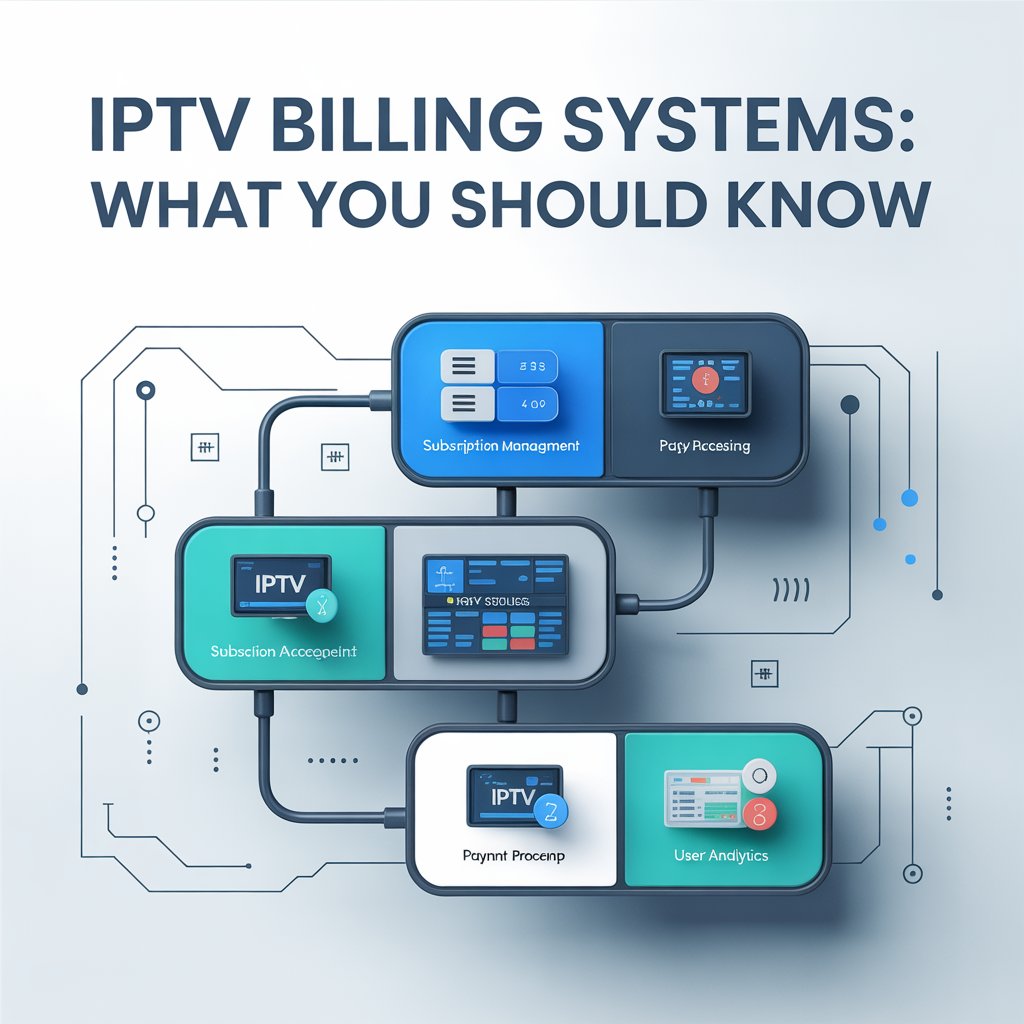
IPTV billing systems are specialized software platforms designed to manage the complete financial lifecycle of streaming services. Unlike generic payment processors, these systems handle the unique requirements of IPTV and OTT businesses, including recurring subscriptions, pay-per-view events, multi-tiered pricing, and complex reseller structures. At their core, IPTV billing systems automate the entire revenue flow from customer acquisition to payment processing and reporting.
Key components include:
- Subscription lifecycle management: From initial signup through renewal, cancellation, and potential reactivation. This includes handling trial periods, grace periods, and dunning management for failed payments.
- Recurring revenue models: Supporting weekly, monthly, and annual billing cycles with flexible pricing structures that can accommodate seasonal promotions or tiered service levels.
- Pay-per-view billing and usage-based pricing: Critical for video-on-demand content, live events, and premium channels where customers pay for specific content rather than a full subscription.
- User authentication and access control: Ensuring subscribers only access content they’ve paid for across multiple devices while preventing credential sharing.
- Revenue management and analytics: Tracking key metrics like ARPU (Average Revenue Per User), churn rate, and lifetime value to inform business decisions.
Basic vs. Advanced IPTV Billing Systems Comparison
| Feature | Basic IPTV Billing | Advanced IPTV Billing Systems |
|---|---|---|
| Integration | Limited panel compatibility | Works with Xtream UI, XUI, NXT Dash, Zenax, Plex, Jellyfin, Emby |
| Automation | Manual provisioning | Instant account creation (<30 seconds after payment) |
| Scalability | Handles <1,000 subscribers | Supports enterprise-level operations with multi-tenant architecture |
| Payment Methods | 2-3 gateways | Multiple gateways including crypto, credit cards, PayPal |
| Customization | Fixed templates | White-label branding with custom domains |
| Support | Email only | Discord/Telegram bots, self-service portals, knowledge bases |
| Analytics | Basic revenue reports | Real-time dashboards with churn prediction and ARPU tracking |
While basic billing solutions might handle simple transactions, advanced IPTV billing systems provide end-to-end automation that scales with your business. As noted by IPTVbp, “The first fully automated IPTV billing platform provisions customers, collects payments, and manages renewals while you sleep.” This level of automation is no longer optional—it’s essential for competing in today’s IPTV market where customers expect instant access and seamless payment experiences.
Key Features of Modern IPTV Billing Systems
Real-Time Billing Integration
Modern IPTV billing systems leverage API-driven gateways for instant processing that connects directly to your streaming platform. This real-time billing integration ensures that when a customer completes payment, their account is provisioned immediately—often in under 30 seconds. Leading platforms like those described in the OTT billing guide support multiple payment methods including credit cards, digital wallets, and cryptocurrencies with automatic currency conversion. The system should integrate seamlessly with popular IPTV panels like Xtream Codes through webhook technology, enabling event-driven automation that triggers account creation, suspension, or renewal based on payment status. This eliminates manual intervention and reduces revenue leakage from delayed provisioning.
Customer Self-Service Portals
A white-label customer portal is essential for reducing support tickets while enhancing user experience. These portals allow subscribers to:
- Update payment methods without assistance
- Modify subscription tiers or add-ons
- View billing history and upcoming charges
- Access knowledge bases for common issues
- Open support tickets with context about their account
As highlighted by IPTVbp, this branded portal becomes the central hub for customer interaction, building trust through transparency while freeing your team to focus on strategic initiatives rather than routine requests. When customers can easily manage their subscriptions, churn decreases significantly—studies show self-service options can reduce support costs by up to 30% while improving customer satisfaction.
Multi-Tenant Billing Architecture
For IPTV providers with reseller networks, multi-tenant billing is non-negotiable. This architecture allows you to:
- Create distinct reseller portals with customized pricing
- Track revenue sharing automatically
- Implement tiered commission structures
- Provide resellers with their own analytics dashboards
The IPTV Pro Panel guide explains the critical distinction between admin and reseller roles: “An IPTV panel admin can manage resellers. A reseller cannot access admin tools.” Advanced billing systems enforce these boundaries while providing resellers with the tools they need to succeed, creating a scalable partner ecosystem that drives growth without compromising control.
Fraud Prevention Mechanisms
Revenue assurance depends on sophisticated fraud detection that monitors:
- Unusual login patterns across multiple devices
- Payment method velocity checks
- Geographic anomalies in viewing behavior
- Credential sharing detection
These systems should automatically flag suspicious activity while minimizing false positives that could frustrate legitimate customers. As noted in industry reports, fraud can account for up to 5% of potential revenue in streaming services—making these tools essential for protecting your bottom line.
Comprehensive Analytics Dashboards
The most valuable IPTV billing systems provide real-time insights through customizable dashboards that track:
- Churn rate and reasons for cancellation
- ARPU trends across different customer segments
- Payment success rates by gateway
- Panel health metrics affecting billing performance
- Customer acquisition cost versus lifetime value
These analytics transform raw billing data into actionable business intelligence. For example, identifying that customers who use the self-service portal have 20% lower churn can justify additional investment in that feature. The right data helps you implement effective churn reduction strategies before problems escalate.
Top IPTV Billing Models and How They Drive Revenue
1. Subscription-Based Revenue Models
The most common IPTV billing model offers predictable recurring revenue through monthly or annual subscriptions. This approach provides steady cash flow while building customer loyalty through consistent service. Successful implementations include:
- Tiered service levels (Basic, Standard, Premium)
- Family plans with multiple simultaneous streams
- Content bundles targeting specific interests (sports, international channels)
The primary advantage is revenue predictability—the $M = n \times p$ formula (where $M$ is monthly revenue, $n$ is subscriber count, and $p$ is price) makes financial planning straightforward. However, this model faces challenges with churn, especially during seasonal viewing lulls. Providers combat this through engagement strategies like exclusive content for long-term subscribers.
2. Pay-Per-View and Transactional Billing
Pay-per-view billing targets premium content opportunities where customers pay for specific events or content rather than ongoing access. This model excels for:
- Live sports events (boxing matches, soccer tournaments)
- New movie releases before they hit subscription tiers
- Special concerts or performances
The revenue potential here follows the formula $R = n \times p \times c$, where $R$ is revenue, $n$ is viewers, $p$ is price per view, and $c$ is conversion rate. While this generates spikes in revenue, it requires sophisticated billing infrastructure to handle sudden traffic surges without technical failures that would lose sales.
3. Hybrid OTT Monetization Strategies
The most successful IPTV providers combine multiple revenue streams through hybrid models:
- Freemium tiers with limited free content and premium upgrades
- Ad-supported basic tiers with ad-free premium options
- Subscription bundles that include pay-per-view credits
Think of it like a gym membership—steady cash flow from base subscriptions with significant upsell opportunities through premium content and features. According to IPTVbp, providers using hybrid models see up to 40% higher ARPU than those relying solely on subscriptions. The key is seamless integration between models so customers can move between tiers without friction.
4. Tiered Pricing with Usage-Based Add-Ons
Advanced IPTV billing systems enable dynamic pricing where base subscriptions include core channels, with additional costs for:
- Premium sports packages
- International channel bundles
- Increased simultaneous streams
- Extended cloud DVR storage
This usage-based pricing IPTV approach maximizes revenue by allowing customers to customize their experience while ensuring you capture value from heavy users. The formula becomes $T = b + \sum (a_i \times u_i)$, where $T$ is total revenue, $b$ is base subscription, $a_i$ are add-on prices, and $u_i$ are usage levels. Providers report 25-30% higher customer satisfaction with this flexible approach compared to rigid tier structures.
Integration and Setup: Step-by-Step Guide
1. Assess Your Specific Needs
Before selecting a billing platform, evaluate:
- Current subscriber count and growth projections
- Content types requiring different billing models (live TV, VOD, PPV)
- Reseller structure needs
- Payment methods preferred by your target market
- Integration requirements with existing IPTV panels
This assessment prevents over- or under-investing in billing capabilities. As noted in the global market report, “Subscription billing management involves overseeing and controlling all aspects of recurring products or services sold through subscription-based pricing models.”
2. Choose the Right Platform
Evaluate options based on:
- Panel compatibility (Xtream UI, XUI, Zenax, etc.)
- Payment gateway diversity
- White-label capabilities
- Reseller management features
- Pricing structure (per-subscriber vs. flat fee)
Consider platforms like IPTVbp that offer “end-to-end automation” or specialized solutions like Muvi for enterprise needs. Open-source options like BillingStack provide flexibility but require more technical expertise to implement.
3. API Configuration for Middleware
Proper API setup connects your billing system to your IPTV panel:
- Configure webhook endpoints for real-time events
- Map subscription tiers to panel packages
- Set up automatic provisioning rules
- Establish dunning management sequences for failed payments
This integration layer is where many implementations fail—ensure your provider offers detailed documentation and support during this critical phase.
4. Compliance and Security Testing
Before launch:
- Verify PCI-DSS compliance for payment processing
- Test fraud detection thresholds
- Validate tax calculation rules for different jurisdictions
- Confirm GDPR compliance for European subscribers
- Stress test for high-traffic scenarios like major sporting events
The OTT billing guide emphasizes that “A reliable OTT billing system aligns with financial and data privacy regulations like GDPR and PCI-DSS, and encrypts user data to keep users’ payment details secure.”
5. Phased Launch with Performance Monitoring
Implement a controlled rollout:
- Start with a small subscriber segment
- Monitor provisioning speed and payment success rates
- Gather user feedback on the checkout experience
- Adjust dunning management before full launch
- Implement A/B testing for different pricing pages
Common pitfalls include poor mobile optimization and complex checkout flows—simplify the process to maximize conversion. Remember that billing isn’t just a technical requirement; it’s a customer experience touchpoint that directly impacts retention.
Challenges and Solutions in IPTV Billing
Common Billing Challenges and Effective Solutions
| Challenge | Impact | Solution |
|---|---|---|
| High churn rate | Revenue instability, increased CAC | Automated retention workflows, win-back campaigns, personalized offers |
| Payment failures | Lost revenue, frustrated customers | Multiple gateway options, automatic retries, diverse payment methods |
| Complex tax compliance | Legal risks, manual correction needs | Built-in tax calculation engines for all jurisdictions |
| Reseller management | Revenue disputes, manual tracking | Automated commission tracking with real-time dashboards |
| Scaling limitations | Service interruptions during growth | Cloud-native architecture with automatic resource allocation |
High churn remains the most critical challenge, often stemming from poor billing experiences rather than content issues. When payment failures aren’t handled gracefully, customers simply abandon their subscriptions. The solution lies in sophisticated subscription lifecycle management that anticipates problems before they cause cancellations. As noted by IPTVbp, automated renewal reminders and seamless payment method updates can recover up to 70% of potentially lost subscribers.
Payment processing diversity is equally crucial—limiting options to just credit cards excludes significant customer segments. Modern IPTV billing systems should support crypto, PayPal, and regional payment methods relevant to your audience. The OTT billing guide confirms that “An OTT billing solution can be integrated with various payment methods, including debit cards, credit cards, digital wallets, and cryptocurrencies.”
For regulatory hurdles, particularly around US sales tax compliance, the right billing system automates complex calculations that would be error-prone if handled manually. This ensures you collect the correct taxes while avoiding penalties—a critical but often overlooked aspect of IPTV billing systems.
Case Studies and Real-World ROI
Provider A: Churn Reduction Through Billing Optimization
A mid-sized IPTV provider serving 15,000 subscribers implemented advanced dunning management and payment method updates through their billing system. By automatically notifying customers of payment issues and making it easy to update cards, they reduced involuntary churn by 32%. This translated to $187,000 in recovered annual revenue with minimal additional cost—achieving a 480% ROI within six months.
Provider B: Reseller Network Expansion
An IPTV business with 5,000 direct subscribers added a reseller program through their upgraded billing platform. The multi-tenant architecture allowed 37 resellers to operate under the main brand with customized pricing. Within nine months, reseller-generated subscribers grew to 12,000 accounts, increasing total revenue by 65% while reducing customer acquisition costs by 40% through the partner network.
Provider C: Hybrid Monetization Success
A sports-focused IPTV service introduced pay-per-view billing for premium events alongside their base subscription. By integrating this seamlessly with their existing billing system, they captured $220,000 in additional revenue during the first major boxing event—representing a 28% revenue uplift for that month alone. The key was frictionless transition from subscription to PPV without requiring separate logins or payment methods.
These examples demonstrate that strategic billing system implementation directly impacts the bottom line—turning what many consider a necessary cost into a growth engine.
Future Trends in IPTV Billing Systems
AI-driven personalization will transform IPTV billing from a transactional process to a strategic retention tool. Systems will analyze viewing patterns to suggest optimal subscription tiers, predict churn risk before cancellations occur, and automatically offer personalized incentives to at-risk customers. Machine learning algorithms will optimize dunning sequences based on individual payment behaviors rather than one-size-fits-all approaches.
Blockchain technology will address two critical challenges: fraud prevention and microtransactions. Decentralized identity verification will reduce credential sharing, while smart contracts will enable secure, transparent revenue sharing with content providers. More significantly, blockchain will facilitate Web3 micropayments for individual pieces of content, allowing viewers to pay fractions of a cent for specific moments rather than entire programs.
5G networks will enable sophisticated usage-based pricing models where billing reflects actual data consumption patterns. Providers could offer “pay-as-you-stream” options where customers pay based on resolution, simultaneous streams, or even specific content genres. This granular approach requires billing systems that can process microtransactions in real-time—a capability already emerging in next-generation platforms.
Conclusion
IPTV billing systems have evolved from simple payment processors to strategic revenue engines that directly impact your service’s growth and profitability. The right system handles subscription lifecycle management seamlessly, reduces churn through intelligent automation, and maximizes revenue through flexible billing models. As the IPTV Pro Panel guide emphasizes, “Understanding this role gives you a clear advantage. Most platforms confuse admin and reseller roles. We don’t.” Your billing infrastructure should provide clear separation of responsibilities while enabling scalability.
Key takeaways every provider must consider:
- Real-time integration with your IPTV panel is non-negotiable for customer satisfaction
- Multiple payment options significantly reduce revenue leakage from failed transactions
- Self-service capabilities directly correlate with lower churn rates
- Analytics-driven insights transform billing data into growth opportunities
- Future-proof systems accommodate emerging models like usage-based pricing
Don’t wait for revenue issues to manifest before auditing your billing setup. The difference between a basic payment processor and a strategic IPTV billing system can mean thousands in recovered revenue each month. Ready to optimize your revenue flow? Schedule a free billing system audit to identify opportunities specific to your IPTV business. In today’s competitive streaming landscape, your billing system isn’t just a necessity—it’s your most powerful growth lever when implemented strategically.