Today’s travelers expect more than a clean bed and a quiet room — they expect the same seamless, personalized entertainment they enjoy at home. When a guest picks up the remote and is greeted by a clunky menu, grainy cable channels, or no way to cast their own Netflix, satisfaction takes a hit before they’ve even unpacked. For hoteliers, that’s an expensive friction point.
IPTV for hotels solves this. Internet Protocol Television (IPTV) replaces legacy coax and satellite feeds with a flexible, IP-based hotel entertainment system that does far more than stream channels. It becomes a branded guest touchpoint, a digital concierge, a revenue channel, and a centralized operations tool — all through one screen.
In this guide, we’ll break down what IPTV is, how it transforms the guest experience, the operational upside for owners and GMs, practical IPTV implementation steps, and how to measure ROI. Whether you run a 40-room boutique or a 250-key mid-scale property, you’ll walk away with a clear path to modernizing your in-room entertainment.
What Is IPTV and How It Differs from Traditional TV
IPTV — Internet Protocol Television — delivers live TV, on-demand video, and interactive services over an IP network (the same kind that powers your Wi‑Fi and PMS) instead of coaxial cable, satellite dishes, or terrestrial antennas. A central headend ingests content, hotel middleware manages navigation and rights, and each room receives the signal through a set-top box or a native hotel smart TV app, rendered via an electronic program guide (EPG).
How it differs from what you already have:
- Legacy cable/satellite is a one-way broadcast: the same 80 channels, in the same order, for every guest, with no interaction.
- OTT services (Netflix, YouTube) stream directly over the public internet on consumer devices — convenient but unmanaged, insecure on shared hotel Wi‑Fi, and impossible to brand.
- Hospitality IPTV sits in the middle: managed, secure, branded, and integrated with your property systems.
For hoteliers, the shift is strategic. Because the platform runs on IP, you gain centralized control: update welcome screens, push promotions, or change channel lineups across every room from a single dashboard. You can tailor content to guest segments, layer in interactive services, and connect entertainment to your PMS, POS, and CRM. In short, the TV becomes a platform — not just a screen.
Helpful background: For a vendor-neutral overview of IPTV standards, the ITU-T Y.1901 series defines the reference architecture used across telecom and hospitality deployments.
Top Ways IPTV Enhances Guest Experience
The strongest argument for an IPTV hotel solution isn’t technology — it’s the guest. Each feature below removes friction, adds delight, or opens a new service channel.
Personalized Welcome Screens and Branded Messaging
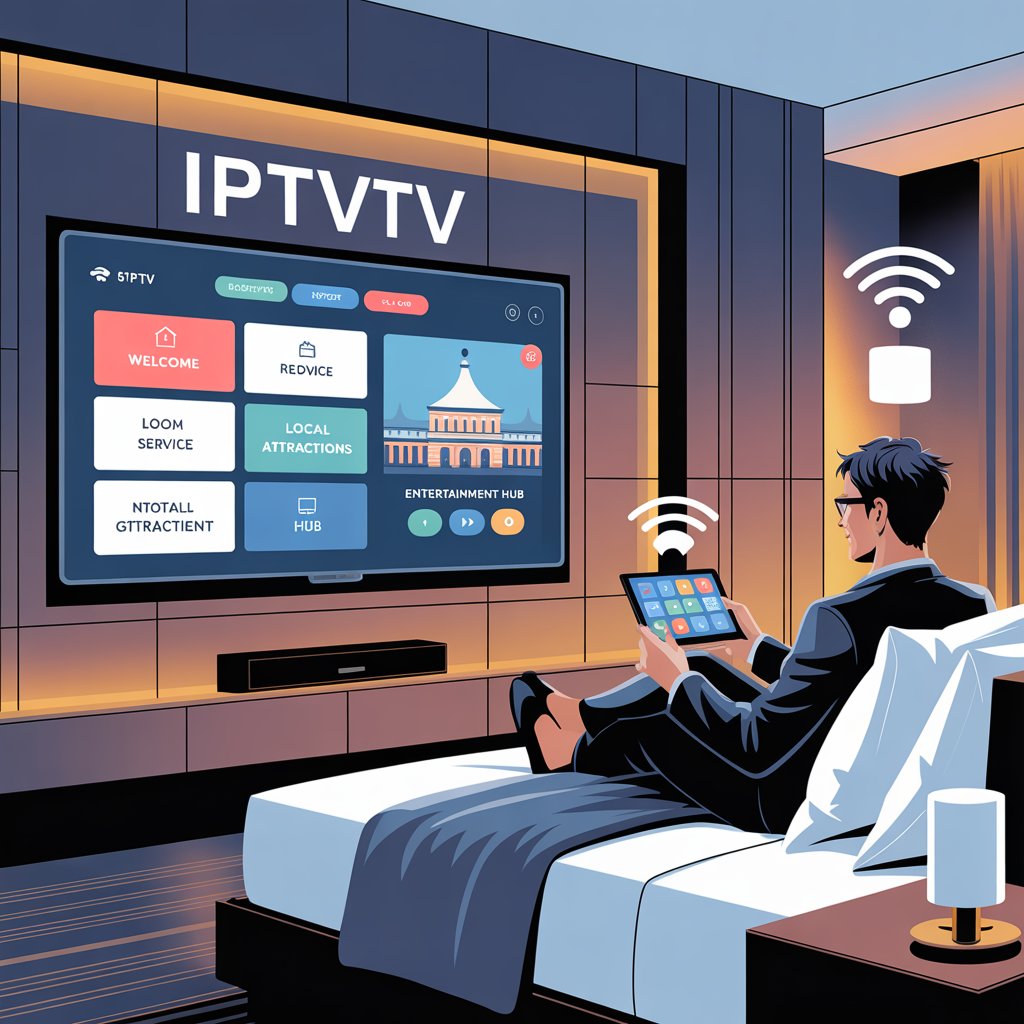
When a guest powers on the TV, they see: “Welcome, Sarah — enjoy complimentary access to our premium channels. Need help? Press ‘Concierge’ on your remote.” That single screen, populated from your PMS reservation, makes arrival feel intentional. It’s also a natural place to surface personalized in-room content: a spa offer for a weekend leisure guest, a meeting-room map for a corporate booking, or a birthday greeting driven by profile data. Upsell conversion on these screens typically outperforms printed tent cards by a meaningful margin — and can be changed nightly without reprinting a thing.
Live TV, On-Demand, and Catch-Up in One Menu
Guests want the simplicity of their home smart TV. A modern in-room entertainment interface bundles live channels, a movie library, catch-up TV (the last 72 hours of selected channels), and apps — all searchable from one EPG. No more hunting through 200 mislabeled channels or flipping to a paper guide.
Safe, Seamless Casting and BYOD Support
The #1 request from modern travelers is the ability to watch their content. Casting in hotel rooms — via Chromecast, AirPlay, or Miracast — lets guests beam Netflix, Hulu, or YouTube from their phone to the TV. Crucially, a well-configured system isolates each session to its room’s VLAN and wipes credentials at checkout, so one guest can’t accidentally (or intentionally) cast to another room.
Multilingual Channels and Localized Content
International guests abandon the TV when they can’t find channels in their language. IPTV lets you carry Arabic, Mandarin, Hindi, Spanish, or German packages without adding physical decoders, and dynamically surface local guides, transport info, and QR-to-translate features on screen.
Interactive Services: The TV as Digital Concierge
A digital concierge menu replaces the printed compendium. Guests can order room service, book a spa slot, request extra towels, browse restaurant menus, explore local recommendations, and express-check-out — all from the remote. Every click goes straight to the relevant system, freeing the front desk from repetitive calls.
PMS Integration and Tailored Preferences
Tight PMS integration lets the system remember that Mr. Tanaka prefers NHK World and a firm pillow, or that the family in 412 booked the kids’ package. Preferences persist across stays for loyalty members, turning a standard room into one that feels known.
Accessibility That Actually Works
Closed captions, audio descriptions, high-contrast UI themes, large-text modes, and voice-assisted navigation make rooms genuinely usable for seniors and guests with disabilities — which is both an ethical obligation and, in many markets, a regulatory one. Accessibility features built into the IPTV UI apply to every piece of content, not just broadcast TV.
Operational and Business Benefits for Hotels
Beyond delighting guests, IPTV benefits for hotels extend straight to the P&L and the GM’s daily workflow.
Centralized Content Management
Updates that once required housekeepers to swap USB sticks or technicians to visit every room now happen from one console. Rate changes, F&B promotions, emergency alerts, and seasonal branding go live property-wide in minutes — a major reduction in maintenance visits and printing costs.
Simpler Licensing and Compliance
A managed IPTV platform makes it obvious what content is licensed where, with reporting on viewership by channel and region. For multi-property groups, this replaces the patchwork of residential cable contracts that frequently violate hospitality licensing terms.
New Revenue Streams
IPTV unlocks a modern pay-per-view hotel catalog, targeted in-room advertising (for local tour operators, restaurants, or airport transfers), and direct upsells — late checkout, spa slots, restaurant reservations — with measurable click-through and conversion tracking. This is a direct input to hotel revenue management strategies.
Lower Long-Term Hardware Costs
With app-based hotel smart TV deployments, there’s no set-top box per room, no IR blasters, no HDMI failures, and no box-level firmware headaches. When a TV is replaced, the app simply lives on the new set. Over a 5–7 year refresh cycle, the TCO is meaningfully lower than legacy coax-plus-STB architectures.
Actionable Hotel Analytics
Hotel analytics from the IPTV platform reveal which channels are watched, which services are ordered, where drop-offs happen in a booking flow, and how casting is used. That data lets you refine F&B offers, cut unused channel packages, and prove engagement to advertisers.
Staff Efficiency
Remote diagnostics mean IT can reboot, update, or troubleshoot a room’s TV from the server room rather than walking there. In a 200-room property, that alone saves dozens of engineering hours per month.
Implementation Considerations and Best Practices
A thoughtful IPTV implementation avoids the two most common failures: under-provisioned networks and over-complicated user interfaces.
Network and Bandwidth
Hotel network requirements are the foundation. Plan for a dedicated VLAN for IPTV traffic, QoS policies that prioritize video, and multicast where your middleware supports it. As a rule of thumb, assume 6–10 Mbps per active stream in unicast mode and design your access layer for peak-hour concurrent usage (typically 40–60% of occupied rooms streaming simultaneously). Wired Ethernet to each TV is strongly recommended over Wi‑Fi for consistency.
Hardware: Smart TV vs. Set-Top Box
- Hotel smart TVs (with hotel-mode firmware and an embedded IPTV client) offer the cleanest guest experience and lowest ongoing hardware cost.
- Set-top boxes make sense when existing TVs must be preserved, or when specialized decoding (e.g., premium sports 4K) is required.
Many properties use a hybrid: smart TVs in renovated wings, STBs elsewhere during a refresh cycle.
Software and Middleware Selection
Choose a hotel middleware vendor based on reliability, CMS flexibility, robust APIs, and proven PMS/POS integrations — not feature count. Ask for references from properties of comparable size and insist on a documented roadmap for IPTV security for hotels (see below).
Content Licensing and Legal
Hospitality use requires venue-level rights, not residential subscriptions. Negotiate geo-rights if you carry international packages, and confirm pay-per-view accounting rules with your content partners before launch.
Guest Privacy and Cybersecurity
Require per-room session isolation, credential wiping at checkout, TLS for all management traffic, and a captive-portal pattern for casting that requires in-room confirmation. For international properties, validate GDPR compliance for any profile data surfaced on screen, and document retention policies. Properties in the U.S. should review any COPPA implications if offering kids’ profiles.
Staff Training, SLAs, and Phased Rollout
Train front desk, concierge, and engineering teams before go-live; their comfort is what guests feel. Negotiate an SLA with defined response times and on-site support windows. Then phase the deployment:
- Pilot: 10–20 rooms covering different room types and network segments.
- Evaluate: 4–6 weeks of usage, feedback, and incident data.
- Scale: Roll out by floor or wing, refining the UI after each phase.
Measuring Success and ROI
Treat guest satisfaction hotel outcomes like any other capital project — with defined KPIs before launch and measurement after:
- Guest satisfaction: NPS/CSAT movement on the “in-room entertainment” and “technology” survey items.
- Usage: Active sessions per occupied room, average session length, casting adoption rate.
- Revenue: Average revenue per occupied room (RevPOR) from PPV, upsells, and in-room ads.
- Ops efficiency: Reduction in TV-related maintenance tickets and average time-to-resolution.
Run an A/B test during the pilot — for example, offer free premium channels to the control group and a PPV menu to the test group — to isolate the revenue impact of each feature.
Illustrative ROI scenario: A 150-room upper-midscale hotel deploys IPTV with a $180K all-in investment. In year one, it saves ~$28K in STB maintenance and printing, earns ~$54K from upsells and PPV, and sees a 6-point NPS lift tied to entertainment. Payback lands inside 24 months, with year-two returns flowing mostly to the bottom line as the hardware is already in place.
Case Study: A Boutique Hotel’s IPTV rollout
The following is a realistic, illustrative example synthesized from common hospitality deployments.
The Linden, a 72-room boutique hotel in a mid-sized European city, ran a legacy satellite system with a printed 40-page in-room directory. Guest surveys consistently flagged “difficult TV” and “outdated room info” as pain points, and front-desk agents spent an estimated 90 minutes per shift answering questions already covered in the compendium.
The hotel deployed a smart-TV-based interactive TV for hotels platform across 15 pilot rooms, integrating it with the PMS, POS, and a local tour-api for recommendations. After six weeks, pilot rooms reported a 14-point CSAT lift on entertainment, a 31% reduction in front-desk calls for directory-style questions, and $11 average incremental RevPOR from spa and late-checkout upsells surfaced on the welcome screen. The Linden then rolled the system out to all 72 rooms over two phases and retired the printed directory entirely — saving roughly $9,000 annually in design, translation, and print costs.
Conclusion and Call to Action
IPTV for hotels has matured from a premium-channel upgrade into a core piece of hotel technology that elevates the guest experience, sharpens operations, and opens measurable new revenue. The properties that win aren’t necessarily the largest — they’re the ones that pilot thoughtfully, integrate with their PMS, and treat the TV as a platform rather than a screen.
Ready to modernize your guest rooms? Start with a 20-room pilot to measure guest satisfaction and revenue uplift before scaling. Reach out to your network integrator for a bandwidth audit, or request a vendor-agnostic demo from two shortlisted middleware providers.