
The IPTV market is experiencing explosive growth. As cord-cutting accelerates and viewers demand seamless, multiscreen experiences, operators face mounting pressure to deliver higher quality at lower cost. Enter artificial intelligence — a transformative force reshaping how video content is ingested, encoded, delivered, personalized, and monetized.
From machine learning models that predict network congestion before a single frame buffers, to recommender systems that surface the perfect show at the perfect moment, AI for streaming is no longer experimental. It is becoming essential infrastructure.
This article explores the most impactful use cases where artificial intelligence enhances Internet Protocol Television across the entire content lifecycle. We will examine how AI drives personalized recommendations, optimizes adaptive streaming quality, automates metadata generation, powers dynamic ad insertion, and strengthens operational monitoring and fraud detection. Along the way, we will address practical implementation challenges and provide actionable guidance for product teams and operators evaluating AI-driven IPTV solutions.
Whether you are a CTO architecting a next-generation platform or a product manager exploring content personalization strategies, this guide maps the opportunities — and the trade-offs — at the intersection of IPTV and AI.
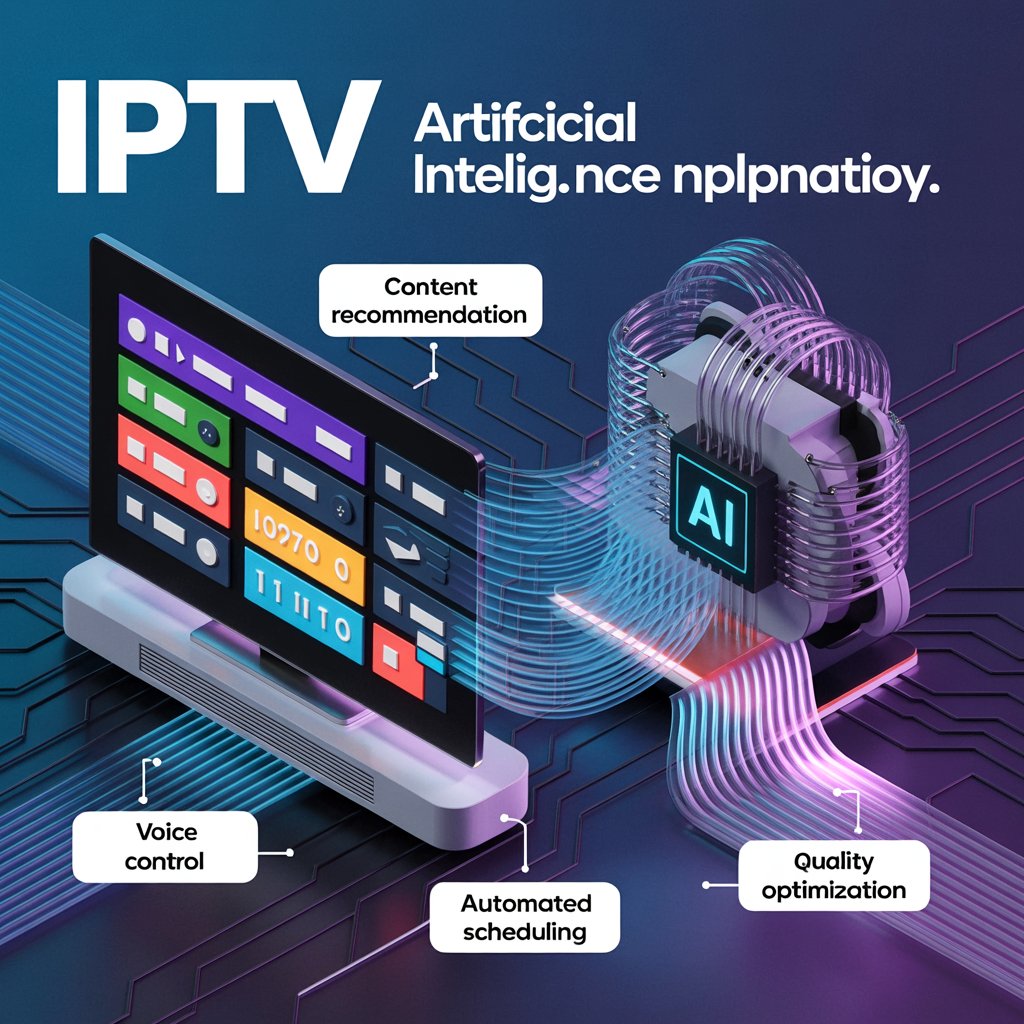
What is IPTV?
IPTV — Internet Protocol Television — delivers television content over IP networks rather than through traditional terrestrial, satellite, or cable formats. Unlike over-the-top (OTT) services that stream over the public internet, IPTV typically operates on managed, private networks, giving operators greater control over quality of service (QoS), bandwidth allocation, and content rights.
The distinction matters. IPTV combines the reliability and channel-surfing familiarity of traditional broadcast with the interactivity and on-demand flexibility of modern streaming. Subscribers enjoy live TV, catch-up services, video on demand (VOD), and time-shifted programming through a unified middleware layer and electronic program guide (EPG).
Today, the market context makes smarter IPTV systems a competitive necessity. Cord-cutting continues to reshape pay-TV economics globally. Viewers expect low-latency live streaming for sports and events, seamless multiscreen consumption across set-top boxes, smartphones, and tablets, and increasingly personalized experiences that rival Netflix or YouTube.
Meanwhile, operators face rising content acquisition costs, shrinking margins, and fierce competition from direct-to-consumer streaming platforms. Legacy infrastructure built for linear channel delivery struggles under these demands. The result is a strong industry push toward AI-driven automation and intelligence embedded throughout the IPTV stack — from the headend to the living room.
How AI Fits the IPTV Stack
A modern IPTV platform comprises several interconnected layers, each presenting distinct opportunities for artificial intelligence and machine learning.
| Stack Layer | AI/ML Opportunities |
|---|---|
| Ingest | Automated QC, content tagging, metadata enrichment, nudity/violence detection |
| Encoding/Transcoding | Per-title codec optimization, perceptual quality models (VMAF), bitrate ladder generation |
| CDN/Delivery | Predictive cache placement, traffic forecasting, intelligent edge routing |
| Middleware/EPG | Recommender systems, NLP-powered search, real-time analytics |
| Client Apps | ML-enhanced ABR, QoE prediction, offline prefetching |
At the ingest layer, AI accelerates quality control and automated metadata enrichment. Computer vision for video can detect encoding artifacts, flag inappropriate content, and extract scene-level tags before content ever reaches the catalog.
In encoding and transcoding, machine learning models optimize codec parameters on a per-title or per-scene basis. Rather than applying a one-size-fits-all bitrate ladder, AI for streaming enables content-aware encoding that reduces bandwidth consumption while preserving perceptual quality.
The CDN and delivery layer benefits from predictive analytics and intelligent routing. AI models forecast traffic spikes and dynamically steer viewers to the best-performing edge nodes, achieving meaningful CDN optimization at scale.
Within middleware and the EPG, recommender systems drive personalized recommendations, while NLP for subtitles and search powers voice-driven program discovery. Finally, at the client layer, ABR (adaptive bitrate) algorithms enhanced by ML predict network conditions and adjust quality seamlessly — directly improving QoE (quality of experience).
Personalized Content Discovery for IPTV
Personalized recommendations represent perhaps the most visible and highest-impact application of AI in IPTV. Modern recommender system architectures draw on three core approaches:
- Collaborative filtering — identifying patterns across similar users
- Content-based filtering — matching content attributes to viewer preferences
- Hybrid models — blending both approaches for superior accuracy
IPTV-Specific Signals That Supercharge Recommendations
What makes IPTV recommendations uniquely powerful is the richness of available signals. Unlike pure VOD platforms, IPTV operators observe:
- Live viewing patterns and channel zapping behavior
- Time-of-day preferences (morning news vs. late-night movies)
- Device type (living room TV vs. mobile commute)
- Pause, rewind, and fast-forward habits during live and recorded content
- Session duration and content completion rates
A viewer who consistently watches Premier League matches on Saturday afternoons, switches to news at 6 PM, and browses documentaries on Sunday morning generates a behavioral fingerprint far more detailed than simple clickstream data. ML models leverage these signals to build dynamic viewer profiles that update in near real-time.
Implementation Considerations
Several factors demand careful attention:
- Privacy — Compliance under GDPR and CCPA requires transparent data collection and user consent mechanisms.
- Cold-start problems — New channels or new subscribers lack interaction history. Content-based approaches, editorial curation, and demographic heuristics bridge this gap until behavioral data accumulates.
- A/B testing — Operators must continuously measure recommendation lift through engagement metrics, session duration, and content discovery rates.
Business Impact
The business case is compelling. Industry benchmarks suggest that effective content personalization can:
- Increase average viewing time by 20–40%
- Reduce subscriber churn by identifying at-risk users before cancellation
- Lift ARPU through better promotion of premium packages and pay-per-view events
💡 Practical starting point: Deploy a hybrid recommender in a secondary UI position (e.g., “Recommended for You” within the EPG) with rigorous instrumentation to measure incremental engagement before expanding the model’s influence.
AI for Adaptive Streaming and Quality Optimization
Video quality optimization is where AI delivers some of its most measurable returns in IPTV. Traditional ABR algorithms react to network conditions after degradation occurs — lowering resolution when throughput drops, then cautiously ramping back up. AI-driven ABR systems take a fundamentally different approach: they predict network conditions before problems manifest.
Predictive ABR and Per-Session Optimization
Machine learning models trained on historical session data learn to recognize patterns — time-of-day congestion, specific ISP behaviors, Wi-Fi signal fluctuations — and proactively adjust bitrate selection, segment prefetching, and buffer management. The result is fewer rebuffering events, faster quality recovery, and a smoother QoE for the viewer.
Perceptual Quality Assessment
Beyond ABR, AI enhances perceptual quality monitoring. Models trained on VMAF (Video Multimethod Assessment Fusion) scores and human opinion data can evaluate video quality in real time without requiring a reference stream — known as no-reference (NR) quality models. This allows operators to detect quality degradation at the edge and trigger remediation before subscribers complain.
Content-Aware Encoding
Cloud transcoding pipelines benefit from per-title encoding powered by ML. The system analyzes each piece of content’s visual complexity — a fast-paced sports broadcast versus a slow-moving talk show — and generates custom bitrate ladders that minimize bandwidth while maximizing perceived quality.
Real-World Impact
A European IPTV operator reduced rebuffering events by ~35% and lowered CDN bandwidth costs by ~18% after deploying ML-driven ABR alongside intelligent CDN optimization — gains that directly improved subscriber satisfaction and the bottom line.
The combined effect across ABR, perceptual monitoring, and encoding optimization makes this one of the most mature and ROI-positive AI use cases in IPTV today.
Automated Metadata and Content Tagging
Rich metadata is the foundation of effective content discovery, targeted advertising, and regulatory compliance — yet generating it manually at scale is prohibitively expensive. AI solves this through automated content tagging powered by computer vision for video and NLP for subtitles.
What AI Extracts from Video and Audio
- Scene recognition — indoor/outdoor, action sequences, dialogue-heavy segments
- Face and celebrity detection — enabling “watch more with this actor” features
- Logo and brand identification — powering contextual ad placement
- Object and location classification — enriching search and browse
- Subtitle auto-generation and topic extraction via NLP
- Sentiment and mood classification — for mood-based recommendations
Downstream Benefits
- Faster content discovery — viewers searching for “scenes with sunsets” or “interviews with a specific athlete” get accurate results.
- Better targeted advertising — contextual ad placement becomes possible when the system knows a cooking segment is about to air.
- Improved EPG and voice search — richer metadata makes conversational queries actionable.
Batch vs. Real-Time Pipelines
Implementation typically involves two modes:
| Mode | Use Case | Timing |
|---|---|---|
| Batch processing | VOD catalog enrichment | During ingest, non-time-critical |
| Real-time tagging | Live streams, live ad insertion | On-the-fly, low-latency |
💡 Tip: Prioritize VOD metadata enrichment first — where processing is non-time-critical and the content library is finite — for a manageable entry point with clear ROI.
Targeted Advertising and Dynamic Ad Insertion
Advertising represents a critical revenue stream for IPTV operators, and AI dramatically amplifies its effectiveness through viewer segmentation, predictive targeting, and server-side ad insertion (SSAI).
AI-Powered Audience Segmentation
Machine learning models analyze viewing behavior, demographics, device usage, and contextual signals to segment audiences into precise cohorts — or even target at the individual household level. A sports fan watching a live match might see athletic wear advertisements, while a drama enthusiast watching the same channel during a different timeslot receives entertainment promotions.
Server-Side Ad Insertion + Dynamic Decisioning
SSAI technology, enhanced by AI, stitches personalized ad breaks directly into the video stream at the server level, ensuring seamless playback across devices and bypassing client-side ad blockers. Dynamic ad insertion algorithms decide in real time which ad creative to serve based on predicted relevance, campaign goals, frequency caps, and available inventory.
Measurement and Attribution
AI models estimate viewability, attention metrics (e.g., was the viewer actively watching?), and conversion likelihood — providing advertisers with ROI evidence that linear TV has historically struggled to deliver.
Privacy and Regulation
Compliance with GDPR and CCPA requires explicit consent for behavioral targeting, transparent data practices, and opt-out mechanisms. Operators must build privacy-by-design architectures — leveraging anonymization, consent management platforms, and contextual (rather than purely behavioral) targeting where appropriate.
Operational Intelligence, Monitoring, and Fraud Detection
Behind the viewer-facing features, AI powers critical operational capabilities that protect revenue and ensure service reliability.
Anomaly Detection and Automated Remediation
Anomaly detection models continuously monitor system logs, encoder outputs, CDN performance, and subscriber sessions to identify issues before they escalate. Unlike rule-based alerting, ML detects subtle deviations — a gradual rebuffering increase on a specific edge node, an unusual viewer drop on a popular channel — and triggers automated remediation through scaling, rerouting, or failover.
Real-time analytics dashboards powered by ML can reduce mean time to detection (MTTD) by 60%+ compared to traditional threshold-based monitoring.
Churn Prediction and Subscriber Lifetime Value
Churn prediction models analyze declining session frequency, reduced content diversity, and support ticket history to flag at-risk accounts weeks before cancellation — enabling proactive retention campaigns and personalized offers.
Piracy Detection and Credential Sharing Detection
Pattern recognition algorithms:
- Identify restreamed content across the internet (piracy detection)
- Detect concurrent streams from shared accounts exceeding policy limits (credential sharing detection)
- Flag anomalous access patterns indicative of compromised credentials
For operators losing significant revenue to unauthorized redistribution, AI-driven detection can recover millions annually.
Reinforcement Learning for Operations
Reinforcement learning is emerging in automated remediation, where systems learn optimal responses to incidents — adjusting bitrate profiles, rerouting traffic, or spinning up CDN capacity — through simulated environments before deploying policies in production.
Implementation Challenges and Best Practices
Deploying AI across an IPTV platform is not without challenges. Product teams should approach implementation pragmatically.
Key Challenges
| Challenge | Mitigation |
|---|---|
| Data quality and labeling | Invest in robust telemetry, consistent collection, and accurate labeling workflows |
| Compute and latency constraints | Use edge computing for real-time inference; leverage cloud for batch workloads |
| Integration with existing systems | Design APIs for backward compatibility with HLS, DASH, CMAF standards |
| MLOps maturity | Continuous training, drift monitoring, versioning, A/B testing frameworks |
| Explainability and bias | Audit recommendation and ad-targeting models for fairness; document decision logic |
| Cost-benefit analysis | Measure ROI per use case before scaling |
Recommended First Steps
- Start with a focused pilot — ML-enhanced ABR, a hybrid recommender, or VOD metadata enrichment.
- Instrument thoroughly — define success metrics (QoE scores, engagement lift, OPEX reduction).
- Measure business impact rigorously — run controlled A/B tests over statistically significant periods.
- Scale what works — let the data guide expansion across the stack.
A minimum viable AI experiment that delivers clear ROI builds organizational confidence and secures budget for broader initiatives.
Future of IPTV with AI
Artificial intelligence is reshaping IPTV across every layer of the stack — from personalized recommendations that keep viewers engaged, to adaptive streaming algorithms that eliminate buffering, to automated metadata pipelines that unlock content value at scale. The operators who invest strategically in AI today are building platforms that are more efficient, more engaging, and more resilient.
What’s Next
- Real-time personalization at the individual scene level during live events
- AI-generated highlights and automated clip creation for social and catch-up
- Real-time multilingual translation and dubbing powered by generative AI
- Improved sustainability through dramatically more efficient encoding and delivery
Start small, measure rigorously, and scale what works. Pilot one AI use case — whether it is a recommender system, intelligent ABR, or automated content tagging — and let the data guide your roadmap forward.
Ready to explore AI for your IPTV platform? Start with a single pilot use case — recommendation, adaptive bitrate, or content tagging — and measure the impact. [Contact our team or download our IPTV + AI whitepaper →]
📋 Summary
| Use Case | Primary Benefit | Maturity Level |
|---|---|---|
| Personalized Recommendations | +20–40% engagement, lower churn | High |
| Adaptive Streaming / ABR | –35% rebuffering, –18% CDN cost | High |
| Automated Metadata & Tagging | Faster discovery, contextual ads | Medium-High |
| Dynamic Ad Insertion (SSAI) | Higher ad revenue, better attribution | Medium-High |
| Operational Intelligence | –60% MTTD, fraud recovery | Medium |
Recommended first pilot: ML-enhanced ABR or hybrid recommender system — both offer clear, measurable ROI with manageable implementation scope.