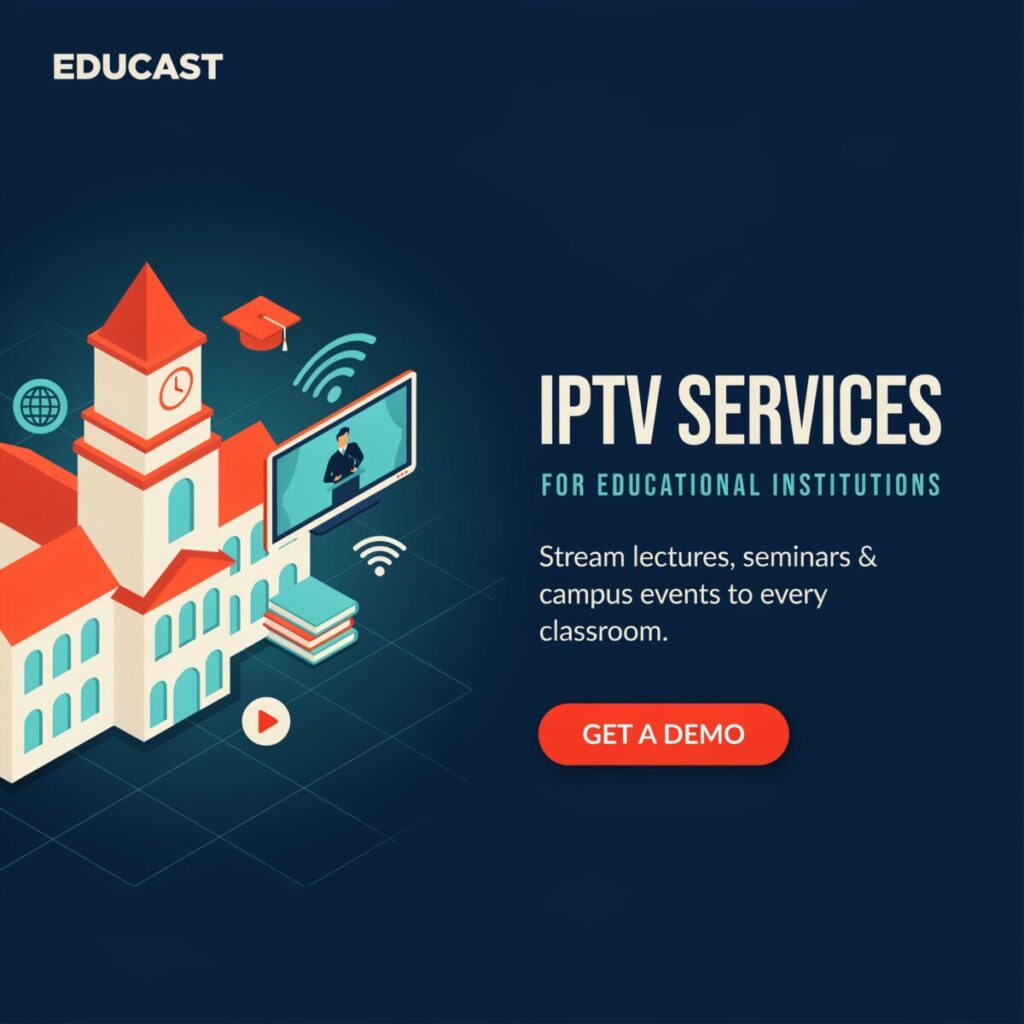
Imagine a campus where every classroom, library, and dorm room is instantly connected to a centralized hub of live broadcasts, on-demand lectures, and emergency alerts. IPTV services for educational institutions are making this seamless multimedia ecosystem a reality, fundamentally transforming how schools teach, communicate, and engage with their students in the digital age.
In today’s hyper-connected educational landscape, media is no longer just an extracurricular add-on; it is the backbone of student engagement, institutional communication, and modern pedagogy. As K–12 schools, colleges, and universities increasingly adopt hybrid learning models, the demand for robust, on-demand video delivery has skyrocketed. Enter Internet Protocol Television (IPTV)—a powerful technology that delivers television and video content over standard IP networks rather than traditional cable or satellite formats.
For school administrators, IT directors, and EdTech coordinators, IPTV in education represents a paradigm shift. It offers a cost-effective, highly secure, and infinitely scalable media delivery platform that enhances instruction, streamlines campus communications, and supports remote learning initiatives. Unlike consumer streaming services, campus IPTV solutions are designed with institutional control, analytics, and integration in mind.
However, migrating to an IP-based video infrastructure is not without its challenges. Decision-makers must carefully navigate bandwidth constraints, stringent security protocols, accessibility compliance, and network quality of service (QoS) requirements. In this comprehensive guide, we will explore what IPTV is, its top applications in academic settings, the tangible benefits it offers, and the technical considerations required for a successful deployment. By the end, you will have a clear roadmap for evaluating and implementing educational IPTV solutions at your institution.
What is IPTV and how it works
At its core, IPTV transmits television and video content over managed IP networks, utilizing the same foundational infrastructure that powers your campus Wi-Fi and wired internet. Unlike traditional broadcast methods that rely on coaxial cables or satellite dishes, IPTV leverages standard networking equipment to deliver high-definition media directly to smart TVs, desktop monitors, and mobile devices. Many legacy educational facilities still rely on outdated RF (Radio Frequency) coaxial systems that are expensive to maintain and lack two-way communication capabilities. Transitioning to IP-based video eliminates these physical limitations.
To understand its value, it is crucial to distinguish IPTV from public Over-The-Top (OTT) services like Netflix or YouTube. While OTT platforms deliver content over the public internet with varying quality, managed campus IPTV operates on a private, localized network. This distinction allows IT departments to guarantee Quality of Service (QoS), prioritize video traffic, and ensure uninterrupted playback even during peak campus usage.
Furthermore, IPTV relies on two primary delivery methods: multicast and unicast. Multicast streaming is highly efficient for live broadcasts—such as a campus-wide assembly or a live sports event—because it sends a single stream that multiple users can tap into simultaneously without multiplying bandwidth consumption. Conversely, unicast is used for on-demand lecture archives, delivering a dedicated stream to an individual student.
Perhaps the most significant advantage of IPTV over traditional cable is its inherent interactivity and integration capabilities. Modern educational IPTV solutions seamlessly plug into existing Learning Management Systems (LMS) like Canvas, Moodle, or Blackboard. This integration transforms passive viewing into an active learning experience, allowing instructors to embed quizzes, push targeted content, and track student engagement analytics directly from a centralized campus communications platform.
Top uses of IPTV in schools and universities
The versatility of IPTV for schools and universities extends far beyond simply replacing cable boxes in dormitories. When deployed strategically, it becomes a multifaceted campus communications platform that serves diverse academic and operational needs.
- Classroom Streaming and Lecture Capture: One of the most impactful uses of IPTV in education is lecture capture streaming. Instructors can record live lectures, which are automatically encoded, archived, and synced with the institution’s LMS. Students can then access on-demand lecture archives to review complex material, pause for note-taking, or catch up on missed classes, significantly improving academic equity and student outcomes.
- Distance Learning and Virtual Classrooms: For hybrid and remote learning models, IPTV provides reliable, high-quality live streaming campus events and daily instruction. Unlike standard video conferencing tools that may struggle with large participant counts, IPTV can broadcast a single instructor to thousands of remote students simultaneously with minimal latency, ensuring a consistent distance learning streaming solution.
- Campus-Wide Announcements and Emergency Alerts: Administrators can use IPTV to override regular programming with critical campus-wide announcements. In the event of severe weather or a security threat, emergency notifications can instantly overlay live channels across every connected screen on campus, ensuring rapid and unified communication.
- Digital Signage: IPTV powers dynamic campus digital signage in cafeterias, libraries, and lobbies. Instead of static posters, screens can display real-time event schedules, dining menus, student achievements, and targeted promotional content, all managed from a single dashboard.
- Event Broadcasting: From graduation ceremonies and guest lectures to collegiate sports, IPTV allows institutions to broadcast live events to overflow rooms, alumni networks, and remote family members, expanding the reach and inclusivity of campus life.
- Library and Media Resources: University libraries utilize IPTV to deliver specialized media resources, such as historical documentaries, language learning modules, and licensed educational films, directly to student devices with strict student access controls and digital rights management (DRM).
- Exam Proctoring: Additionally, some institutions leverage secure IPTV feeds for remote exam proctoring, providing administrators with access-controlled, low-latency video monitoring of testing environments without requiring third-party software on student devices.
Key benefits of IPTV for education
Adopting IPTV services for educational institutions yields substantial operational, financial, and pedagogical advantages that traditional AV setups simply cannot match.
- Cost Savings and Consolidation: One of the most immediate benefits is IPTV cost savings for schools. By transmitting video over existing IP networks, institutions can drastically reduce the need for expensive coaxial cabling, proprietary AV hardware, and ongoing cable TV subscriptions. Consolidating internet, data, and video onto a single network reduces maintenance overhead and minimizes the number of vendor relationships IT staff must manage.
- Scalability Across Campuses: Whether you are a single K-12 campus or a multi-campus university system, IPTV is inherently scalable. Adding a new classroom or dormitory to the network requires only a standard Ethernet drop or Wi-Fi connection, rather than a complex, dedicated AV installation. This makes managed IPTV for universities an ideal long-term investment that grows seamlessly alongside institutional expansion.
- Enhanced Accessibility and Equity: Modern educational institutions must comply with ADA and Section 508 accessibility standards. IPTV systems natively support IPTV accessibility closed captioning, multi-language audio tracks, and screen-reader compatibility. This ensures that all students, including those with hearing or visual impairments, have equal access to educational content, fostering a more inclusive learning environment.
- Interactivity and Analytics: Unlike passive broadcast television, IPTV enables two-way communication. Instructors can embed interactive voting, real-time quizzes, and push notifications directly into the video stream. Furthermore, IT and academic departments gain access to granular analytics on content consumption. By tracking which lectures are most frequently watched or where students tend to pause and rewind, educators can refine their teaching methods and improve instructional design.
- Content Repurposing and E-Waste Reduction: Content created for one purpose can be easily repurposed across the institution. A recorded guest lecture can be archived in the library, clipped for a promotional social media campaign, and broadcast on digital signage in the student union, maximizing the return on investment for every piece of media produced. Furthermore, by leveraging existing displays and smart TVs via lightweight software apps or inexpensive streaming sticks, schools can reduce electronic waste associated with constantly replacing proprietary hardware decoders.
Technical considerations and network planning
While the benefits are clear, deploying content delivery over IP requires meticulous network planning to ensure a seamless user experience and robust security.
- Bandwidth Planning and QoS: Video is bandwidth-intensive. IT directors must conduct thorough IPTV bandwidth planning to estimate peak concurrent streams. Utilizing multicast for live linear channels drastically reduces network strain, while adaptive bitrate streaming education protocols ensure that on-demand video quality dynamically adjusts based on a user’s available bandwidth, preventing buffering. Furthermore, implementing network QoS for media and VLAN segmentation ensures that video traffic does not choke out critical administrative data or research networks.
- Security and Privacy Compliance: Secure video streaming for students is paramount. Campuses must enforce strict user authentication via SSO (SAML/OAuth) integrated with existing identity providers like Azure AD or Google Workspace. Role-based access controls ensure that only enrolled students can view specific course materials, maintaining compliance with FERPA (student privacy) regulations. Additionally, DRM and SSL/TLS encryption protect licensed educational content from unauthorized downloading or piracy.
- Hardware Compatibility: A successful campus IPTV deployment must be device-agnostic. The platform should support a wide array of endpoints, from legacy set-top boxes and smart TVs in lecture halls to web browsers and mobile apps for remote learners. Seamless IPTV and LMS integration is equally critical, allowing students to access video content directly within their familiar Canvas or Blackboard dashboards without requiring separate logins.
- Backup and Caching: To ensure high availability, institutions should implement local caching servers and robust backup/DR strategies. In the event of an external internet outage, locally cached lecture captures and emergency broadcast capabilities should remain fully operational, ensuring that learning and critical communications never stop.
- Content Delivery Networks (CDN): For institutions with a massive global alumni base or widespread remote learners, integrating a CDN ensures that high-demand video assets are cached at edge locations, drastically reducing latency and origin server load.
Choosing between managed, self-hosted, and hybrid IPTV
When procuring educational IPTV solutions, institutions generally face three deployment models: managed, self-hosted, and hybrid.
- Managed IPTV Providers: A fully managed service is ideal for K-12 districts or smaller colleges with limited in-house IT staff. The vendor handles hosting, server maintenance, software updates, and 24/7 support. This model offers fast deployment, predictable subscription-based pricing (OPEX), and strong Service Level Agreements (SLAs), allowing internal teams to focus on pedagogy rather than server management.
- Self-Hosted (On-Premises): Large research universities with massive IT teams and strict data sovereignty requirements often prefer self-hosted deployments. This CAPEX-heavy model requires purchasing on-premises servers and licensing software, but it grants total control over the infrastructure, data, and custom integrations. It is best suited for institutions with specific compliance mandates that prohibit cloud hosting.
- Hybrid Deployments: A hybrid IPTV deployment offers the best of both worlds. Core infrastructure and on-demand archives may be hosted in the cloud for scalability, while local edge servers cache live streams and emergency broadcasts to minimize WAN bandwidth usage.
When evaluating an IPTV vendor for education, look for those offering flexible licensing, free campus pilot programs, and proven experience navigating the unique compliance needs of the academic sector.
Implementation roadmap and best practices
A successful rollout requires a phased approach rather than a campus-wide flip of the switch. Securing early stakeholder buy-in from faculty senate and student government is also crucial; when end-users understand the direct benefits to their daily academic routines, adoption rates increase exponentially.
Begin with a pilot program in a single department or dormitory. Define clear pilot metrics—such as stream uptime, latency, and user adoption rates—and gather qualitative feedback from instructors and students. Once the pilot proves successful, execute a phased rollout. This must be accompanied by comprehensive staff training. Instructors need to understand how to operate streaming hardware, apply proper metadata tagging, and ensure all uploads meet accessibility standards.
Equally important is establishing strong content governance. Create clear policies regarding content ownership, retention schedules (e.g., deleting semester-old lecture captures to save storage), and permission tiers. Finally, continuously monitor network performance and user analytics to optimize bandwidth allocation and ensure ongoing ADA and Section 508 compliance.
Case study: Mid-Sized University Transformation
Consider a hypothetical mid-sized university, “Oakridge College,” which struggled with an aging, coaxial-based campus TV system and disjointed lecture capture tools. By migrating to a managed campus IPTV solution, Oakridge consolidated its AV vendors and eliminated expensive cable contracts.
The IT team utilized multicast streaming for campus events and integrated the IPTV platform directly with their Canvas LMS. Within the first academic year, Oakridge reported a 35% reduction in AV support tickets and a 40% increase in on-demand lecture view counts among remote and hybrid students. Furthermore, during a severe winter storm, the administration successfully utilized the IPTV emergency override to broadcast real-time safety instructions to every smart TV in the dormitories and student union, proving the system’s critical value beyond just academic delivery.
Next steps and resources
IPTV represents a foundational upgrade for modern educational infrastructure, bridging the gap between physical classrooms and digital learning environments. By delivering secure, scalable, and interactive media, institutions can dramatically enhance student engagement and streamline campus-wide communications.
Is your network ready to support the next generation of classroom video delivery? We invite you to evaluate your current infrastructure and explore how educational IPTV solutions can meet your institution’s unique needs. Download our free IPTV network readiness checklist, or contact our EdTech consulting team today to schedule a custom demo and campus pilot assessment.