Over 50 million global IPTV users in 2026 demand seamless streaming—but which IPTV streaming protocols actually dominate the landscape? Whether you’re watching live cricket on a Firestick in Lahore, catching Premier League action on an Android box in London, or binge-streaming on demand in New York, the protocol powering your stream determines everything: buffering frequency, picture quality, latency, and reliability.
IPTV streaming protocols are the standardized rules that govern how video and audio data is encoded, packaged, transmitted across IP networks, and decoded on your screen. They’re the invisible architecture behind every pixel of your stream. Without the right protocol matched to your use case, even the fastest internet connection will leave you staring at a loading spinner.
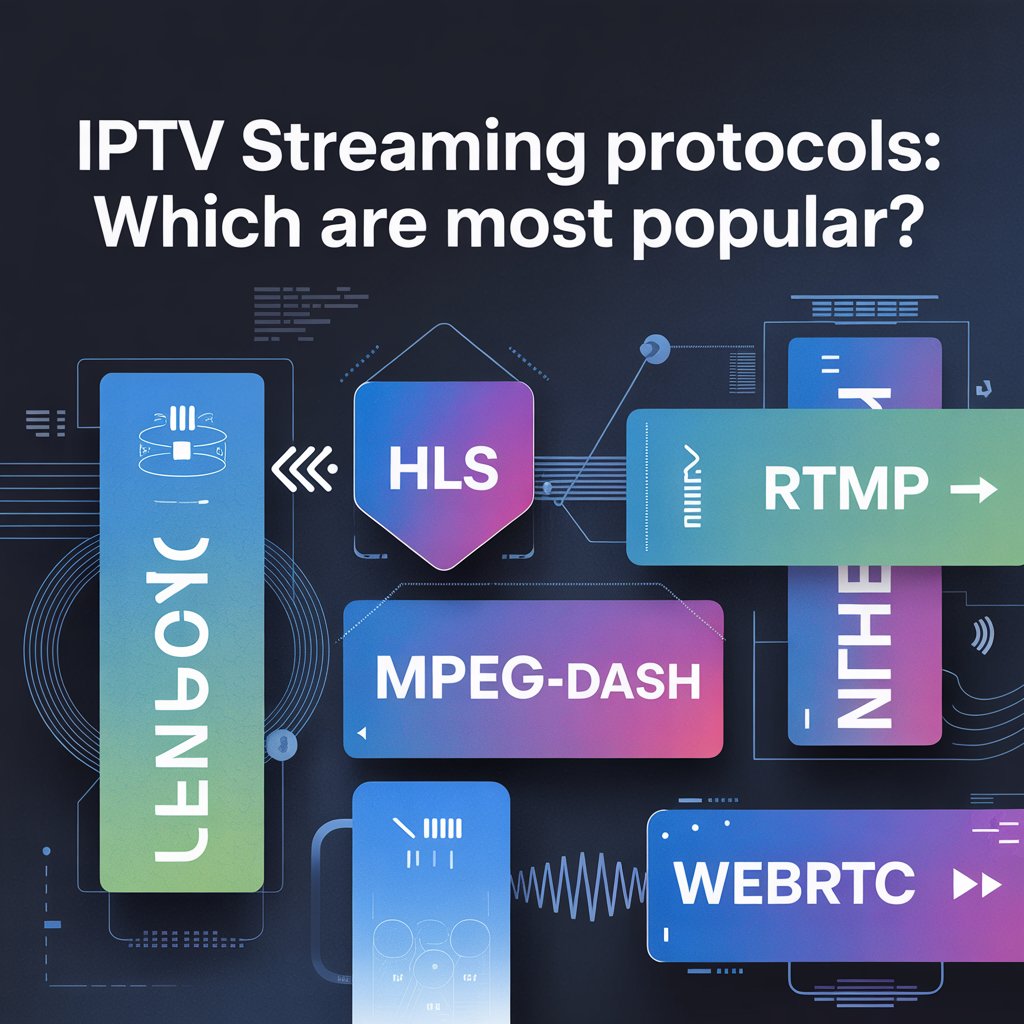
In 2026, the most popular IPTV protocols—including HLS, MPEG-DASH, RTMP, and RTP—have evolved significantly. Adoption across leading platforms like IPTV Smarters Pro, TiviMate, and Xtream Codes has reshaped which protocols matter most. Is HLS still the king of adaptive bitrate streaming, or does RTMP IPTV still rule live broadcasts? And where do emerging technologies like WebRTC and QUIC fit in?
This guide ranks and explains the most popular IPTV streaming protocols by real-world adoption, compares their performance across key use cases, and helps you choose the right one for your setup—whether you’re prioritizing low latency for live sports or maximum compatibility for 4K VOD.
What Are IPTV Streaming Protocols?
At their core, IPTV streaming protocols are the communication standards that dictate how your TV content travels from a server to your screen over an internet connection. Think of them as the “language” that streaming infrastructure speaks—and if your device and the server aren’t speaking the same language, your stream breaks down.
These protocols operate across several distinct functional layers:
| Protocol Layer | Examples | Role in IPTV |
|---|---|---|
| Transport | UDP, TCP | Handles raw packet delivery across the network |
| Presentation | RTP, RTCP | Manages real-time sequencing and timing of media |
| Application/Control | RTSP, HTTP | Controls session setup, tearback, and stream requests |
| Adaptive Delivery | HLS, MPEG-DASH | Dynamically adjusts quality based on bandwidth |
Unicast vs. Multicast is the fundamental architectural split in IPTV delivery. Unicast streaming sends a dedicated stream to each viewer individually—ideal for on-demand content but bandwidth-intensive at scale. Multicast streaming sends a single stream that multiple viewers receive simultaneously, making it highly efficient for live broadcasts with large audiences. The IGMP (Internet Group Management Protocol) manages multicast group memberships on your local network.
UDP vs. TCP is the transport layer choice. UDP (User Datagram Protocol) prioritizes speed—it sends packets without confirming receipt, which means lower latency but potential for packet loss. TCP (Transmission Control Protocol) ensures every packet arrives correctly, making it more reliable but introducing latency. Most modern IPTV protocols are built on top of one or the other depending on their design priorities.
Understanding these layers helps you make sense of why different IPTV streaming protocols excel in different scenarios—and why there’s no single “best” protocol for every situation.
Top IPTV Streaming Protocols Explained
1. HLS (HTTP Live Streaming)
Latency: 10–30 seconds | Compatibility: Excellent | Best For: VOD, broad device support
Developed by Apple and introduced in 2009, HLS (HTTP Live Streaming) has become the most widely adopted IPTV streaming protocol in 2026. Its core mechanism is elegant: the video stream is divided into small segments (typically 2–10 seconds long), delivered sequentially over standard HTTP connections.
How HLS works: The server generates an M3U8 playlist file that indexes all available stream segments at multiple quality levels. Your player reads this playlist, evaluates your current network bandwidth, and requests the appropriate quality segment—seamlessly switching quality up or down as your connection fluctuates. This is the essence of adaptive bitrate streaming (ABR).
Why HLS dominates:
- Native support on iOS, macOS, Android, Samsung Smart TV, LG WebOS, Roku, Firestick, and virtually every modern browser
- Works over standard HTTP/HTTPS, meaning it passes through firewalls and CDNs without special configuration
- Excellent CDN compatibility for global content distribution
- Low operational complexity for IPTV providers
The trade-off: HLS latency is its Achilles’ heel. Standard HLS introduces 10–30 seconds of delay—acceptable for VOD but painful for live sports when your neighbor’s screen shows the goal three seconds before yours. Apple’s Low-Latency HLS (LL-HLS) specification, now widely implemented, brings this down to 2–5 seconds, significantly closing the gap.
HLS remains the backbone of most international IPTV services, including those serving Pakistan, the UK, and North America. If your IPTV app loads an M3U playlist, there’s a very strong chance it’s serving HLS streams.
2. MPEG-DASH (Dynamic Adaptive Streaming over HTTP)
Latency: 6–30 seconds | Compatibility: High (excluding native iOS) | Best For: 4K streaming, multi-platform deployments
MPEG-DASH (Dynamic Adaptive Streaming over HTTP) is HLS’s most formidable competitor and the only truly codec-agnostic, international open standard for adaptive bitrate streaming—published by ISO/IEC. Where HLS was Apple’s proprietary creation (later made royalty-free), DASH was designed from the ground up by a consortium of industry players including Microsoft, Netflix, and Google.
What sets MPEG-DASH apart:
- Codec flexibility: Unlike HLS (originally tied to H.264), DASH supports H.264, H.265/HEVC, VP9, AV1, and any future codec—making it inherently more future-proof for 4K and 8K streaming
- DRM integration: DASH integrates cleanly with multiple DRM systems (Widevine, PlayReady, FairPlay) through the MPEG Common Encryption standard, making it the protocol of choice for premium content providers
- Segment granularity: DASH offers finer-grained segment control, enabling more aggressive quality adaptation and potentially lower latency with proper configuration
- Open standard: No single company controls the specification, which matters for long-term ecosystem health
MPEG-DASH vs HLS: The two protocols are functionally very similar—both segment video, both use adaptive bitrate logic, both run over HTTP. The key differences are codec support, DRM handling, and ecosystem politics. Netflix uses DASH internally. YouTube uses DASH. Disney+ and HBO Max lean on DASH for their premium tiers. However, HLS remains dominant in the IPTV middleware market (Xtream Codes, Stalker Portal) because of its Apple device compatibility.
The iOS limitation: Safari on iOS does not natively support MPEG-DASH, requiring either a JavaScript-based player (which adds overhead) or server-side conversion. This is why many IPTV services serve HLS to iOS users and DASH to Android and web users.
For viewers streaming 4K content—particularly on Android boxes and smart TVs—MPEG-DASH often delivers superior results thanks to better codec support and DRM flexibility.
3. RTMP (Real-Time Messaging Protocol)
Latency: 1–5 seconds | Compatibility: Medium (declining) | Best For: Live stream ingest, Twitch-style broadcasting
RTMP (Real-Time Messaging Protocol) was developed by Macromedia (later Adobe) originally for Flash-based media delivery. Despite Flash’s death in 2020, RTMP has proven remarkably resilient—not as a delivery protocol to end viewers, but as the standard live stream ingest protocol used by virtually every broadcasting platform on earth.
When a sports broadcaster goes live, their encoding software (OBS, Wirecast, FFmpeg) almost certainly pushes the stream to the origin server via RTMP. The server then transcodes and repackages it into HLS or DASH for final delivery to viewers.
RTMP in 2026:
- Still the dominant ingest protocol for live IPTV and streaming platforms
- Supported natively by streaming encoders, capture cards, and broadcast hardware
- Offers low latency (1–5 seconds) compared to HLS
- Not natively supported by modern browsers (requires a media server like Nginx-RTMP or Wowza to transcode)
Some IPTV services, particularly those serving sports and live events, maintain RTMP delivery to legacy set-top boxes. But for most consumer IPTV setups in 2026, RTMP operates behind the scenes rather than as the end-user delivery protocol.
4. RTP/RTSP (Real-Time Transport Protocol / Real-Time Streaming Protocol)
Latency: 0.5–2 seconds | Compatibility: Medium (professional/enterprise) | Best For: Low latency IPTV, pro AV setups
RTP (Real-Time Transport Protocol) is the workhorse of real-time media delivery—defined in IETF RFC 3550. It runs over UDP and handles the sequencing, timestamping, and delivery monitoring of live audio and video packets. RTCP (RTP Control Protocol) accompanies RTP to provide quality feedback and synchronization between streams.
RTSP (Real-Time Streaming Protocol), defined in IETF RFC 7826, is the control protocol that manages RTP sessions—think of it as the TV remote for an RTP stream (play, pause, seek commands).
Where RTP/RTSP shines:
- Ultra-low latency IPTV deployments—sub-2-second delay is achievable
- Professional broadcast and enterprise video distribution
- IP cameras and CCTV systems
- Telco-grade IPTV delivered over managed networks (where packet loss is controlled)
The challenge with RTP over open internet is UDP’s vulnerability to packet loss. On unmanaged networks (standard broadband), dropped UDP packets cause visible artifacts or dropouts. This is why RTP is preferred in controlled network environments rather than over-the-top (OTT) internet delivery.
5. UDP Multicast / IGMP
Latency: <1 second | Compatibility: Limited (managed networks only) | Best For: Large-scale live TV distribution
UDP Multicast with IGMP (Internet Group Management Protocol) is the protocol architecture behind traditional cable TV replacement at scale. Instead of sending individual streams to each viewer (unicast), multicast sends one stream that multiple devices on the same network segment receive simultaneously.
In IPTV multicast vs unicast streaming, the efficiency gain is dramatic: a single 10 Mbps 4K stream can serve 1,000 simultaneous viewers using the same 10 Mbps of network bandwidth. This makes multicast the preferred architecture for telco IPTV providers (like PTCL in Pakistan or BT in the UK) delivering live channels over their own managed fiber networks.
The limitation is that multicast doesn’t cross standard internet routing. It works within local networks or purpose-built multicast-enabled network infrastructure—not over the public internet. For most cord-cutters using OTT IPTV services, UDP multicast is invisible or inaccessible.
Protocol Comparison Table
| Protocol | Latency | Compatibility | Best For | 2026 Popularity (1–10) |
|---|---|---|---|---|
| HLS | 2–30s (LL-HLS: 2–5s) | Excellent (all devices) | VOD, broad streaming | 9.5 |
| MPEG-DASH | 6–30s | High (not native iOS) | 4K, DRM content | 8.0 |
| RTMP | 1–5s | Medium (ingest/legacy) | Live ingest, sports | 6.5 |
| RTP/RTSP | 0.5–2s | Medium (pro/enterprise) | Ultra-low latency live | 5.0 |
| UDP Multicast | <1s | Low (managed networks) | Telco/ISP IPTV | 4.5 |
Which IPTV Streaming Protocols Are Most Popular in 2026?
Based on adoption data across major IPTV middleware platforms and streaming infrastructure reports, HLS commands approximately 60% of the IPTV streaming market in 2026. MPEG-DASH holds around 25%, with the remaining 15% split between RTMP, RTP, and multicast deployments.
Why HLS leads: The combination of universal device support, CDN compatibility, and the maturation of Low-Latency HLS has cemented HLS as the default choice for virtually every new IPTV service launch. Apps like IPTV Smarters Pro and TiviMate are architected primarily around HLS M3U playlist delivery.
Why MPEG-DASH is gaining ground: As 4K streaming becomes mainstream and content providers require robust DRM, MPEG-DASH adoption is growing—particularly in premium and enterprise IPTV tiers. The AV1 codec’s rise (delivering equivalent quality at 40% lower bitrate than H.264) is accelerating DASH adoption since HLS’s AV1 support is newer and less mature.
Protocol by use case in 2026:
- Live sports (low latency priority): LL-HLS or RTMP → HLS pipeline
- 4K VOD with DRM: MPEG-DASH
- Casual live TV on Firestick/Android box: Standard HLS
- Enterprise/telco IPTV: UDP Multicast
- Pro broadcast contribution: RTMP ingest
Pros, Cons, and Real-World IPTV Protocol Comparison
Scenario 1: Live cricket on a Firestick HLS with LL-HLS enabled delivers the best balance here—2–5 second latency is acceptable, Firestick support is native, and adaptive bitrate streaming automatically adjusts quality if your broadband fluctuates during peak hours. If your IPTV provider offers RTMP → HLS pipeline with a well-configured Wowza or Nginx media server, you’ll get reliable, low-buffer performance.
Scenario 2: Netflix-style 4K VOD library MPEG-DASH is the clear winner. The codec flexibility (H.265/HEVC, AV1) delivers better picture quality at lower bitrates. DRM integration protects premium content. Quality adaptation handles variable bandwidth elegantly for large 4K files.
Scenario 3: Gaming stream on a budget Android box RTMP → HLS is still common for Twitch-style gaming streams. The ingest leg uses RTMP for minimal encoder latency; the delivery leg uses HLS for broad compatibility.
IPTV Buffering Solutions: Regardless of protocol, buffering is often a symptom of network congestion or provider infrastructure—not the protocol itself. Using a wired Ethernet connection instead of Wi-Fi, enabling adaptive bitrate in your IPTV player, and pairing your service with a quality VPN (for throttling bypass) addresses most buffering issues. HLS and DASH’s ABR mechanisms are your first line of defense against variable bandwidth.
Choosing the Right IPTV Protocol for Your Setup
Follow this decision framework to choose your ideal protocol:
- Identify your primary use case: Live sports demand lower latency (LL-HLS, RTMP). VOD libraries prioritize quality and compatibility (HLS, MPEG-DASH).
- Check your device ecosystem: iOS users need HLS. Android, smart TV, and web users can leverage either HLS or MPEG-DASH. Enterprise setups on managed networks may benefit from RTP/multicast.
- Assess your bandwidth: Adaptive bitrate protocols (HLS, MPEG-DASH) are forgiving of variable connections. RTP/UDP multicast require more stable network conditions.
- Test with a flexible player: Apps like GSE Smart IPTV, TiviMate, and IPTV Smarters support multiple protocol sources. Load both an HLS and MPEG-DASH stream from your provider (if available) and compare performance on your specific network.
- Consider your provider’s infrastructure: Future-proof IPTV protocols require provider-side support. Ask whether your service supports LL-HLS or MPEG-DASH before assuming the latest spec is available.
The Future of IPTV Streaming Protocols
Two technologies are reshaping the horizon of IPTV streaming protocols:
WebRTC (Web Real-Time Communication) is gaining serious traction for ultra-low latency IPTV—delivering sub-500ms latency, making it viable for truly interactive live streaming and real-time sports experiences. Platforms are beginning to deploy WebRTC for “stadium-sync” live TV where sub-second latency is essential.
QUIC (Quick UDP Internet Connections), the transport protocol underlying HTTP/3, is being integrated into both HLS and DASH delivery pipelines. QUIC reduces connection setup time, handles packet loss more gracefully than TCP, and performs significantly better on mobile and high-latency connections—directly addressing IPTV buffering on mobile networks in markets like Pakistan.
Expect these emerging IPTV protocols to complement (rather than replace) HLS and MPEG-DASH over the next 2–3 years.
Conclusion
In 2026’s IPTV landscape, HLS remains the undisputed #1 streaming protocol—unmatched in device compatibility and steadily improving on latency through LL-HLS. MPEG-DASH is the smart choice for 4K and DRM-protected premium content. RTMP continues to power live broadcast ingest behind the scenes, while RTP/RTSP and UDP Multicast serve professional and telco deployments where network conditions allow.
The best IPTV protocol isn’t universal—it’s the one that matches your device, network, content type, and provider infrastructure. Now it’s your turn: which IPTV streaming protocol does your current setup rely on, and have you noticed a difference in quality or buffering when switching between them? Share your experience in the comments, or subscribe for more IPTV tech updates to stay ahead of the next shift in streaming technology.