Imagine this: It’s the final minutes of the FIFA World Cup final. You’re watching live on your IPTV service — and instead of the dreaded spinning buffer wheel, the picture is razor-sharp, the audio is flawless, and every tackle registers in real time. No lag. No pixelation. Just pure, immersive sports broadcasting from the comfort of your living room.
This isn’t a fantasy anymore. It’s the promise — and increasingly the reality — of 5G IPTV integration.
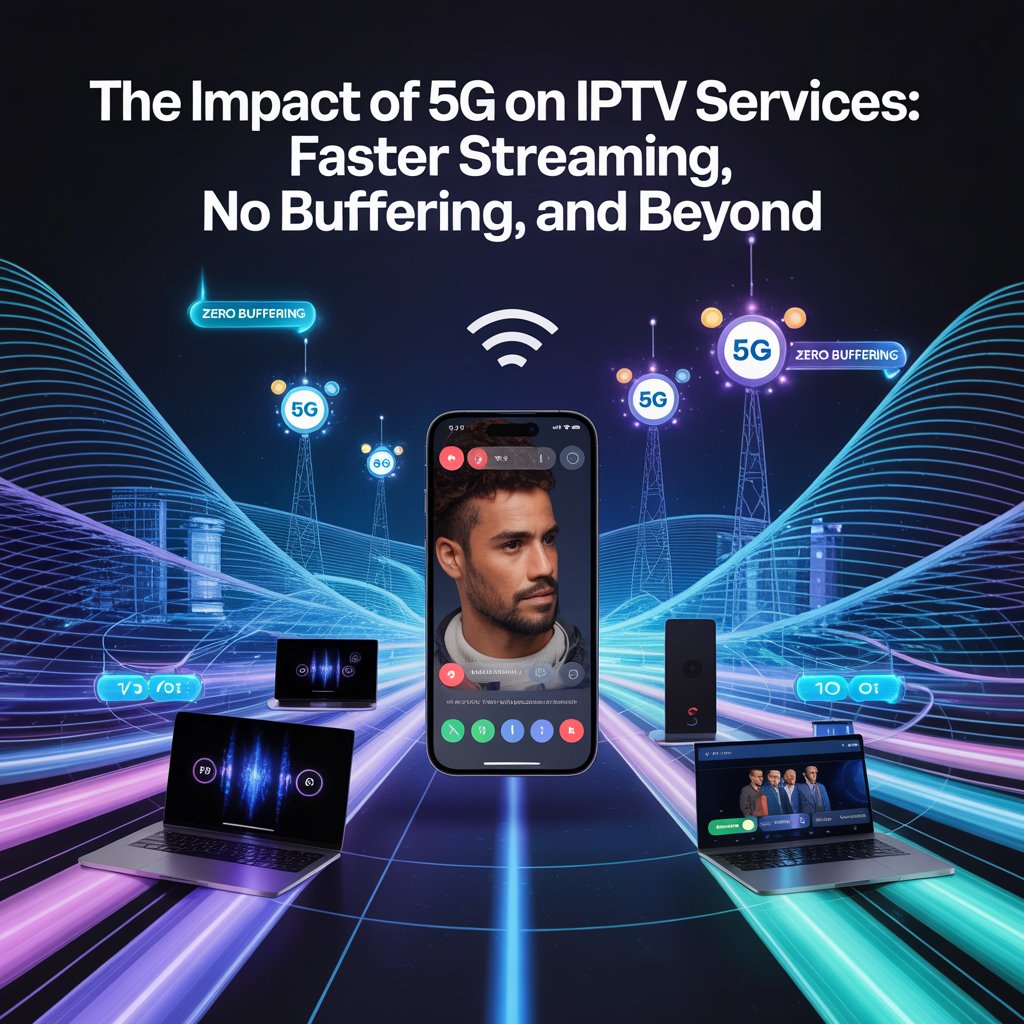
The impact of 5G on IPTV services is nothing short of revolutionary. Internet Protocol Television (IPTV) delivers TV content over internet networks rather than traditional satellite or cable. For years, it has battled the constraints of bandwidth limits, network congestion, and inconsistent connection quality. Enter 5G — the fifth generation of mobile networks — built to handle up to 10 Gbps speeds and as low as 1 millisecond latency. Together, these two technologies form a partnership that is redefining what “watching TV” even means.
In this article, we’ll explore how 5G is turbocharging IPTV services: eliminating buffering, enabling crystal-clear 4K and 8K streams, opening the door for AR/VR content, and powering seamless mobile IPTV accessibility. Whether you’re an IPTV provider, a telecom professional, or simply a cord-cutter tired of buffering during peak hours, read on — the future of streaming has already arrived.
The Technical Foundations: How 5G Supercharges IPTV
To understand the impact of 5G on IPTV services, it helps to peek under the hood. 5G is built on three core pillars defined by the ITU (International Telecommunication Union):
- Enhanced Mobile Broadband (eMBB): Delivers blazing-fast speeds for data-heavy applications — precisely what bandwidth-intensive 4K/8K video streaming demands.
- Ultra-Reliable Low Latency Communication (URLLC): Enables real-time responsiveness, critical for live events and interactive IPTV features.
- Massive Machine-Type Communications (mMTC): Supports an enormous density of connected devices simultaneously — ideal for multi-device IPTV households.
Think of 4G LTE as a busy two-lane country road. It gets the job done on a quiet Sunday morning. Now imagine 5G as a 16-lane superhighway with zero traffic lights, smart lanes, and a GPS that reroutes instantly. That’s what IPTV gets when 5G arrives — and the difference is transformative.
Here’s a quick look at the key metric improvements that directly benefit streaming:
| Metric | 4G LTE | 5G | IPTV Impact |
|---|---|---|---|
| Peak Download Speed | ~100 Mbps | Up to 10 Gbps | Supports 8K multi-stream households |
| Latency | 30–70 ms | < 1 ms | Eliminates live event delay |
| Device Density | ~2,000/km² | ~1 million/km² | Stadium-scale IPTV deployments |
| Reliability | ~99.9% | 99.999% | Near-zero service interruptions |
| Spectrum Efficiency | Moderate | 3–5× improvement | Better VOD scalability |
These numbers tell a compelling story. The spectrum efficiency for VOD scalability alone means IPTV providers can serve dramatically more concurrent viewers without degrading quality — a game-changer during major live events when millions tune in simultaneously.
Ultra-low latency streaming is perhaps the most exciting technical gift 5G brings to IPTV. Latency in video streaming is like the gap between turning on a coffee machine and getting your first cup. Drip brew takes minutes (4G — noticeable lag in live events); a pod machine delivers in seconds (5G — near-instant response). For sports fans watching a penalty kick, that difference between seeing it live vs. 30 seconds after their neighbor is everything.
Key Benefits of 5G for IPTV Services
1. Seamless Live Streaming and 5G-Enabled Live Sports Broadcasting
Live sports have always been the crown jewel — and the Achilles’ heel — of IPTV. The simultaneous spike in viewership during peak moments creates network bottlenecks that result in buffering and quality drops. 5G changes that equation entirely.
With 5G-enabled live sports broadcasting, network slicing (more on that below) can dedicate a guaranteed slice of bandwidth to live IPTV traffic, ensuring that even in a packed stadium or a busy urban neighborhood, your stream doesn’t skip a beat. Verizon’s 5G Ultra Wideband trials at NFL stadiums demonstrated that fans could simultaneously stream multiple live camera angles on their phones — a feature previously impossible at scale.
The 2022 Beijing Winter Olympics offered a glimpse of this future, with China’s state broadcaster deploying 5G infrastructure to deliver 4K live feeds with sub-second latency to millions of viewers — a landmark moment for 5G IPTV integration.
2. Immersive AR/VR Content Delivery
Virtual reality IPTV experiences require enormous bandwidth and ultra-low latency — conditions that 4G simply cannot consistently provide. Streaming an 8K 360-degree VR video in real time demands upwards of 100 Mbps with latency under 20ms to avoid motion sickness.
5G makes AR/VR content delivery viable at scale. Imagine watching a Premier League match from a virtual front-row seat, turning your head to follow the ball, with real-time crowd audio surrounding you. Or attending a virtual concert through your IPTV app, where you can “walk” to different vantage points. These aren’t distant pipe dreams — SK Telecom and Deutsche Telekom have both run successful 5G-powered VR live event pilots.
For IPTV providers, investing in AR/VR content delivery today means positioning for what analysts at Ericsson predict will be a $1.2 trillion extended reality market by 2030 — with immersive video content at its core.
3. Mobile IPTV Accessibility and Multi-Device Synchronization
One of the most tangible everyday benefits of 5G for consumers is dramatically improved mobile IPTV accessibility. On 4G, streaming HD video on the go was possible but often unreliable. On 5G, you can comfortably stream 4K content on a smartphone, continue on your smart TV at home, and pick it back up on your in-car infotainment screen — all without missing a frame.
This is enabled by multi-device IPTV synchronization, where the IPTV platform tracks your position in the content and hands off seamlessly between devices. 5G’s combination of high bandwidth and low latency makes this handoff nearly instantaneous, creating a truly “anywhere, anytime” television experience.
Families with multiple simultaneous streamers in different rooms — or on different devices — will particularly benefit. A household that previously struggled to maintain quality across three concurrent 4K streams can now support six or more without degradation.
4. Edge Computing for IPTV: Reducing Latency at the Source
Edge computing for IPTV is one of the less-publicized but profoundly impactful benefits of the 5G era. Traditional IPTV architectures route data from the viewer’s device all the way back to a central data center — a journey that adds latency and creates bottleneck points.
With 5G networks, edge computing nodes can be deployed much closer to the user — sometimes within a few kilometers. Content caching, transcoding, and delivery processing happen at the “edge” of the network rather than in distant cloud infrastructure. The result? Lower latency, faster startup times, and reduced backhaul costs for providers.
For 5G private networks for enterprises — think hotels, hospitals, airports, and sports stadiums deploying their own 5G infrastructure — edge computing for IPTV enables bespoke content delivery. A hotel chain, for example, can run its own IPTV system with localized content, interactive menus, and advertising — all processed on-site, with guaranteed QoS optimization in 5G networks for every guest.
5. IPTV Buffering Reduction: The End of the Spinning Wheel
Perhaps the most universally celebrated benefit is IPTV buffering reduction. Buffering stems from two sources: insufficient bandwidth and high latency. 5G attacks both simultaneously.
Quantifiably, studies from 5G Americas indicate that 5G networks reduce video startup time by up to 70% compared to 4G, and rebuffering rates drop by over 80%. For IPTV providers, this translates directly to higher viewer satisfaction, longer session times, and lower churn rates. For users, it simply means television that works — every time.
Challenges and Solutions in 5G IPTV Rollout
Despite the enormous promise, the road to widespread 5G IPTV deployment comes with real obstacles. Understanding them is essential for IPTV providers and telecom operators planning their strategies.
The Key Challenges:
- Infrastructure Costs: 5G requires significantly more base stations than 4G due to its higher-frequency (millimeter wave) spectrum, which has a shorter range. Dense urban deployments can cost billions.
- Spectrum Availability: Governments must auction spectrum bands, and this process moves slowly. Many markets — including developing economies — are still years away from nationwide 5G coverage.
- Device Compatibility: Older IPTV set-top boxes and routers are not 5G-compatible. Transitioning subscriber hardware is expensive and logistically complex.
- Cybersecurity Risks: A more connected, software-defined 5G network creates new attack surfaces. IPTV platforms must implement end-to-end encryption and zero-trust security models.
- Backhaul Bottlenecks: Even where 5G radio access is deployed, the underlying fiber backhaul connecting towers to the core network may be insufficient to handle increased traffic.
Solutions and Mitigation Strategies:
- Implement Network Slicing in Streaming: Network slicing in streaming allows operators to carve out dedicated, virtualized lanes of bandwidth specifically for IPTV traffic. This guarantees QoS even during congestion, as IPTV packets are prioritized over general browsing data. It’s like having an express checkout lane at the supermarket — you bypass the queue entirely.
- Deploy Edge Computing for IPTV: Shifting processing workloads to edge nodes reduces the burden on backhaul infrastructure and cuts latency, addressing both bottleneck and speed challenges simultaneously.
- Adopt a Hybrid 5G/Fiber Strategy: Where 5G coverage is spotty, IPTV providers can implement intelligent network switching that seamlessly routes traffic between 5G and fixed-line broadband — ensuring continuity for subscribers regardless of location.
- Phase Hardware Upgrades Strategically: Rather than replacing all subscriber equipment at once, providers can begin with 5G-capable Wi-Fi 6E routers that are 5G-ready at the gateway level, while gradually introducing 5G-native set-top boxes.
- Future-Proofing IPTV Infrastructure with 5G-Advanced and 6G Preparation: The ITU has already defined 5G-Advanced (Release 18 and beyond) and begun 6G research targeting 2030 commercialization. IPTV infrastructure designed today should use open, software-defined architectures that can be upgraded via firmware rather than hardware replacement — a critical step in future-proofing IPTV infrastructure.
Real-World Case Studies and Future Outlook
The impact of 5G on IPTV services is no longer theoretical. Several real-world deployments offer concrete proof of what’s possible.
AT&T’s 5G IPTV Trials (USA): AT&T has been trialing 5G-based IPTV delivery for its DirecTV Stream platform in select markets, demonstrating that millimeter-wave 5G can substitute for fiber broadband as a last-mile delivery mechanism for premium IPTV content — including 4K HDR live sports.
China Telecom’s 5G IPTV Platform: China is arguably the global leader in 5G IPTV deployment. China Telecom’s 5G-powered VOD platform serves over 200 million IPTV subscribers, leveraging massive 5G infrastructure rollouts to deliver 4K and 8K content to tier-1 and tier-2 cities. Their integration of edge computing has reduced average stream startup time to under one second.
South Korea’s Holographic IPTV Experiments: KT Corporation has demonstrated 5G-enabled holographic video calls and live sports broadcasts, offering a preview of what 5G-Advanced holographic IPTV might look like by 2028. These experiments combine ultra-low latency streaming with light-field display technology for a glasses-free 3D experience.
Pakistan’s 5G Progress: Closer to home for many readers, Pakistan’s telecom regulator (PTA) has been advancing 5G spectrum auctions, with major operators like Jazz, Telenor, and PTCL eyeing 5G launches in major urban centers. PTCL’s existing IPTV service (Smart TV) is well-positioned to benefit from 5G as spectrum becomes available, potentially transforming its offering for subscribers in Lahore, Karachi, and Islamabad.
Looking Ahead: By 2027, GSMA Intelligence forecasts that 5G will account for over 25% of global mobile connections. For IPTV, the convergence of AI-driven content personalization, network slicing in streaming, and 5G-Advanced capabilities points toward a future where your IPTV platform knows what you want to watch, delivers it in whatever format your screen supports, and adapts quality in real time — all invisibly, and all flawlessly.
Conclusion
The impact of 5G on IPTV services is comprehensive and accelerating. From eliminating buffering and enabling 4K/8K streaming without compression, to powering AR/VR content delivery and enterprise-grade 5G private networks for businesses — 5G is not merely an upgrade to existing IPTV infrastructure. It is a complete reimagining of what IPTV can be.
For users and providers ready to ride this wave, here are five practical steps to take right now:
- Upgrade your home router to a Wi-Fi 6 or 6E model that is 5G-gateway-ready — this ensures your in-home network won’t bottleneck your 5G IPTV integration before the signal even reaches your TV.
- Test your IPTV apps for ultra-low latency streaming support — check provider settings for adaptive bitrate (ABR) streaming options optimized for 5G networks.
- Ask your IPTV provider about network slicing in streaming — forward-thinking providers are already offering QoS tiers that prioritize video traffic on 5G-connected plans.
- Explore 5G mobile IPTV plans — if your telecom operator offers a 5G plan, trial streaming your IPTV service on mobile to experience the difference in mobile IPTV accessibility firsthand.
- Stay informed on local 5G rollout timelines — knowing when 5G reaches your city lets you plan infrastructure and subscription upgrades ahead of the curve, rather than scrambling to catch up.
Ready for buffer-free IPTV? Share your thoughts below — and tell us: will 5G replace cable TV entirely in your household within the next five years?
Subscribe to our newsletter for the latest IPTV tech updates, 5G rollout news, and streaming guides delivered straight to your inbox.
FAQ: 5G and IPTV Services
Q: How does 5G improve IPTV? 5G improves IPTV by providing substantially higher bandwidth (up to 10 Gbps), ultra-low latency (under 1ms), and greater device density. This combination eliminates buffering, supports 4K/8K video, enables AR/VR content delivery, and ensures reliable multi-device IPTV synchronization.
Q: What is network slicing in streaming? Network slicing in streaming is a 5G feature that allows operators to create virtualized, dedicated “lanes” of network capacity for specific applications — like IPTV. It guarantees that video traffic receives priority bandwidth and latency guarantees, regardless of overall network congestion.
Q: Will 5G work without fiber broadband for IPTV delivery? Yes — in many cases. 5G, particularly millimeter-wave (mmWave) 5G, can deliver speeds comparable to fiber broadband wirelessly. This makes 5G a viable “wireless fiber” solution for last-mile IPTV delivery, especially in areas where laying fiber is cost-prohibitive.
Q: What is edge computing for IPTV and why does it matter? Edge computing for IPTV means processing and caching content closer to the end user — at network edge nodes rather than distant central data centers. This reduces latency, speeds up stream startup, and reduces backhaul load — leading to a better viewing experience, especially for live content.
Q: When will 5G IPTV be mainstream? In leading markets like South Korea, China, and parts of the USA and Europe, 5G IPTV integration is already a present-day reality. For developing markets, mainstream availability is projected between 2026 and 2030, depending on spectrum auction timelines and infrastructure investment.